
A team handoff message should let the next owner act without chasing the sender for missing context. That means naming who owns the work, what is true right now, what could go wrong, and what needs to happen first.
The best handoffs are not long project recaps. They are clear transfers of responsibility that make it obvious where the work stands and who has authority to move it forward.
What a team handoff message needs to accomplish
A useful handoff message gives the incoming owner enough context to act, a current status they can trust, and explicit next steps with ownership. If any of those pieces are missing, the recipient is left to infer priorities, hunt for files, or ask questions that should have been answered before the transfer.
Think of a handoff as a movable package of work, not a historical archive. The recipient does not need every meeting note or every past version of a document. They need the goal, the important decisions already made, the state of open work, and the authority to make the next call.
Many generic templates fail because they stop at "Alex will take this over." That identifies a recipient, but it does not establish decision authority, reveal open risks, or assign a first action. A real handoff answers: What can Alex decide? What might block progress? What should Alex do first?
Use this team handoff message template
Use this template in Slack, email, or a project-management comment. Keep the fields that affect action and remove anything that does not help the new owner make a decision.
Copy-ready template
Handoff: [workstream or project] to [new owner]

[New owner] is taking ownership of [workstream] and can [make decisions / approve changes / coordinate with specific stakeholders].

Objective: [desired outcome] by [date or milestone].
Current status: [Brief, factual summary of where the work stands.]
Completed: [Completed item or decision]; [Completed item or decision]
Open items: [Open task], owned by [name], due [date]; [Pending approval, dependency, or question]
Risks or blockers: [What could delay or change the work, including dependencies and deadlines.]
Source of truth: [Link to project page, brief, ticket, decision log, or folder]
First action: [New owner] will [specific action] by [date/time].
Next checkpoint: [Meeting, update, or decision point] on [date/time].
Questions and escalation: Contact [name] for [topic]. Escalate [specific issue] to [name or team].

[New owner], please reply by [time] to confirm receipt, access, and your first action.
Subject or opening: Handoff: [workstream or project] to [new owner]
Owner and authority: [New owner] is taking ownership of [workstream]. They can [make decisions / approve changes / coordinate with specific stakeholders].
Objective: The goal is to [desired outcome] by [date or milestone].
Current status: [Brief, factual summary of where the work stands.]
Completed:
- [Completed item or decision]
- [Completed item or decision]
Open items:
- [Open task], owned by [name], due [date]
- [Pending approval, dependency, or question]
Risks or blockers: [What could delay or change the work, including dependencies and deadlines.]
Source of truth: [Link to project page, brief, ticket, decision log, or folder]
First action: [New owner] will [specific action] by [date/time].
Next checkpoint: [Meeting, update, or decision point] on [date/time].
Questions and escalation: Contact [name] for [topic]. Escalate [specific issue] to [name or team].
Acknowledgment: [New owner], please reply by [time] to confirm receipt, access, and your first action.
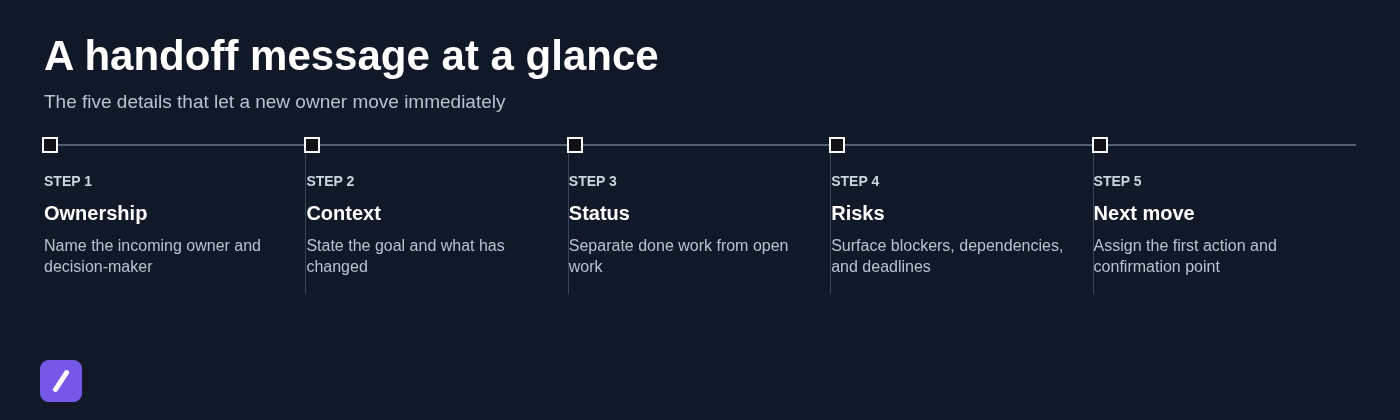
Write the handoff in the right order
Put context first, then status, risk, and action. Recipients need to understand what the work is before they can correctly interpret a list of tasks or a warning about a blocker.
Link to the source of truth rather than pasting a sprawling history into the message. A project brief, ticket, shared folder, or decision log can hold the detail; the handoff should point the recipient to the right place and explain what matters there.
Most importantly, name the incoming owner, not merely the team. "Marketing owns this now" is vague. "Priya owns the launch plan and is the decision-maker for channel changes" creates accountability.
Context: explain what the work is and why it matters
Give the recipient two to four sentences that explain the customer or business goal, the current project objective, a decision already made, and any constraints that affect the next move. Include background only when it changes the new owner's choices.
For example, "This is the onboarding update for Enterprise customers. We decided to launch the revised checklist before the October renewal cycle, but Legal must approve the updated data-retention language before publishing." That is far more useful than a generic "We're updating onboarding."
Status: separate facts, decisions, and unresolved work
Make completed work, work in progress, pending approvals, and unanswered questions easy to scan. Do not blend them into a single paragraph where a reader has to guess whether an item is finished or merely discussed.
A short decision log is useful when prior trade-offs are likely to be questioned. For instance, note that the team chose a phased launch because support capacity is limited, then link to the rationale. That prevents the incoming owner from reopening a settled issue by accident.
Next steps: assign the first move, due date, and escalation path
"Please take it from here" is not a handoff. It is an invitation for ambiguity. The message should state one immediate action, the due date, the next checkpoint, and the person who can resolve likely questions.
Instead, write: "Jordan will confirm the vendor's revised timeline by Tuesday at 2 p.m. and post the result in the project ticket. If the date slips beyond October 10, escalate to Morgan for a scope decision." The recipient now knows exactly where to begin.

Choose the channel and level of detail
Use the channel that matches the urgency and durability of the handoff. Slack works well for visible, time-sensitive coordination. Email is better for a formal cross-team record or a vacation coverage notice. A project-management tool is usually the best home for durable task ownership and ongoing progress.
For reusable guidance on structuring messages in chat, see these Slack message templates.
When a handoff includes multiple files, stakeholders, or updates over several days, point every channel back to one canonical project page. Do not create slightly different versions of the same handoff in Slack, email, and a ticket. Post the full record where the work lives, then use the other channels to notify people and link back.
For example, a Slack message can state the incoming owner, first action, and deadline, while linking to the project task containing the complete status and decision history. That keeps the urgent coordination visible without turning chat into an unreliable document repository.
Team handoff examples for common situations
Project owner handoff message
Slack message
Handoff: Q4 customer onboarding update to Priya.
Priya is now the project owner and can make content and rollout decisions with Support and Product. The goal is to publish the revised onboarding flow by October 18.
Current status: Content drafts are complete and Support has reviewed the new help-center links. Engineering is blocked on final Legal approval for the data-retention copy.
Completed: Scope approved; draft walkthrough recorded; support macros updated.
Open: Legal approval is due October 9. Engineering needs final copy before starting implementation.
Decision log: [link]
Risk: A Legal delay past October 9 puts the October 18 release at risk.
First 24-hour action: Priya, please confirm the Legal review owner and delivery date by 3 p.m. tomorrow, then post a project status update in the task.
Next checkpoint: Launch readiness review, October 10 at 11 a.m.
Priya, please reply by end of day to confirm access to the project task and acceptance of ownership.
Out-of-office handoff email for vacation
Subject: Coverage handoff for [dates]: [your workstream]
Hi team,
I will be out of office from [start date] through [return date]. During that time, [coverage owner] will handle active work for [workstream] and has authority to make routine decisions and coordinate updates.
Priority work:
- [Priority item]: current status [status]; next action [action] by [date].
- [Priority item]: current status [status]; dependency or deadline [detail].
Routing: Send routine questions about [topic] to [coverage owner]. For urgent issues involving [specific condition], contact [escalation owner]. Please do not hold items for my response while I am away.
Access and references: [Project page or folder link], [shared inbox or ticket queue], [relevant documentation link].
First 24-hour action: [Coverage owner], please review the priority list on [date] and confirm that you can access the required files and systems.
I return on [return date]. Any work that can wait until then should be noted in [project tool or queue].
Thanks,
[Name]
Work handover email during resignation or role change
Subject: Transition handover: [responsibilities or workstream]
Hi team,
As responsibilities transition on [date], [new owner] will take ownership of [workstream]. The goal is continuity for the team, customers, and partners, with no interruption to recurring work.
Key responsibilities:
- [Recurring responsibility], including [cadence and key deadline]
- [Customer, vendor, or internal relationship], with main contact [name and role]
- [Project or system responsibility], current status [status]
Open work and risks: [List unresolved items, upcoming deadlines, access gaps, or stakeholder dependencies.]
Documentation: [Link to runbook, project list, account notes, or shared folder.]
First 24-hour action: [New owner], please review the recurring-work calendar and confirm ownership of the next due item by [date].
Escalation: Contact [manager or designated teammate] for decisions that fall outside the documented process.
Please reply to confirm receipt, access to the required tools, and any gaps that need to be resolved before [transition date].
Thank you,
[Name]
Add a decision log when the work includes unresolved choices
Add a decision log when the next owner must secure an approval, choose between viable options, or work around a trade-off that affects scope, timing, or budget. It keeps decisions visible instead of burying them in a status update.
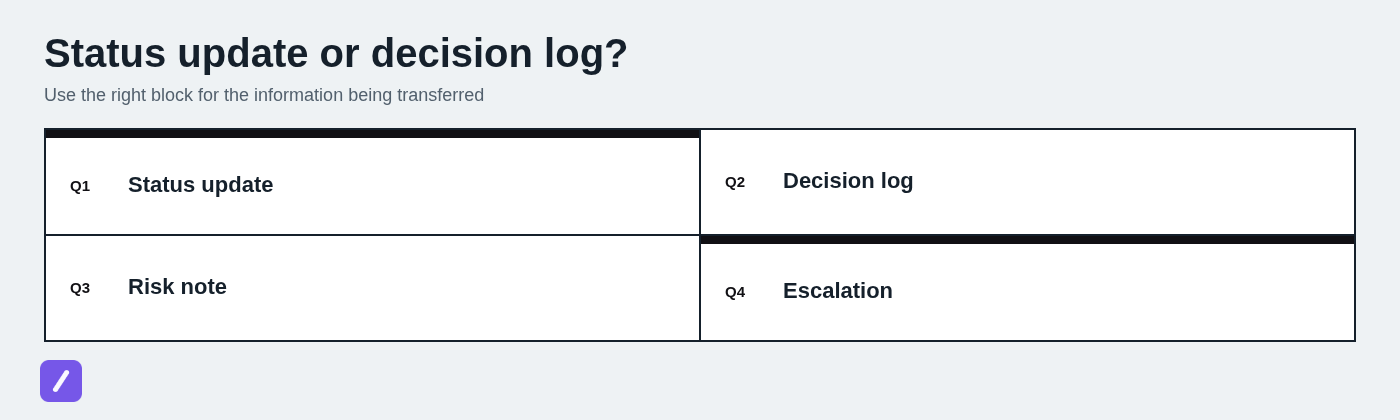
A status update tells people what changed and what is due next. A decision log identifies a choice, who must make it, and when. Those are different jobs, and combining them often hides the one detail that can block the project.
Decision needed: [Describe the choice.]
Options: [Option A] / [Option B] / [Option C]
Recommendation: [Recommended option and brief reason.]
Decision owner: [Name]
Decision deadline: [Date and time]
Context: [Link to brief, estimate, customer feedback, or supporting document]
Keep the decision log compact. The handoff is not the place to restate every argument; it is the place to make clear that a decision is pending and who must resolve it.
Avoid the handoff mistakes that create dropped work
Use this pre-send checklist to prevent dropped work:
- Name one incoming owner and their decision authority.
- Label the first action, assign a due date, and name an escalation contact.
- Separate confirmed facts from assumptions, open questions, and risks.
- Link to deeper documentation instead of pasting history or unrelated tasks.
- Confirm the incoming owner can access the linked files, tools, and relevant records.
Make repeatable handoffs easier to send
Save approved handoff language for the situations your team repeats: project coverage, vacation coverage, role transitions, decision requests, and status confirmations. Then customize the owner, dates, risks, and first action instead of rewriting the structure every time.
For team announcements connected to a transition, an internal process change announcement template can help organize the change, timing, and responsibilities.
SnipFlux can store reusable handoff, out-of-office, and Slack message templates behind shortcuts across Chrome, macOS, and Windows, making it easier to start from a consistent format while still tailoring the details to the work.
A handoff succeeds when the recipient can identify the owner, current reality, risk, and next move without chasing the sender. If they can do that, the work has genuinely changed hands.