
A scope change request email should ask for approval before work starts, state exactly what is changing, and show the impact on time, cost, effort, or dependencies. The goal is not simply to notify people of a change. It is to make a documented decision easy.
That distinction prevents a common project problem: a vague email is treated as permission, the team starts work, and nobody agrees on who approved the added scope. A clear request protects the project, the client relationship, and the people doing the work.
What a scope change request email needs to accomplish
A good scope change request email turns a project detail into a decision. The recipient should be able to see what is proposed, why it matters, what it will affect, and what you need from them.
An approval email is different from a status update. A status update may say that a requirement changed or a risk emerged. A scope change request says, "Here is the proposed revision and its impact. Please approve, decline, or request changes before we proceed."
It is also not a replacement for a formal change-control form when your contract, organization, or project governance requires one. Think of the email as the decision-ready summary and written record. The attached change request, revised statement of work, or project log can carry the detailed specifications.
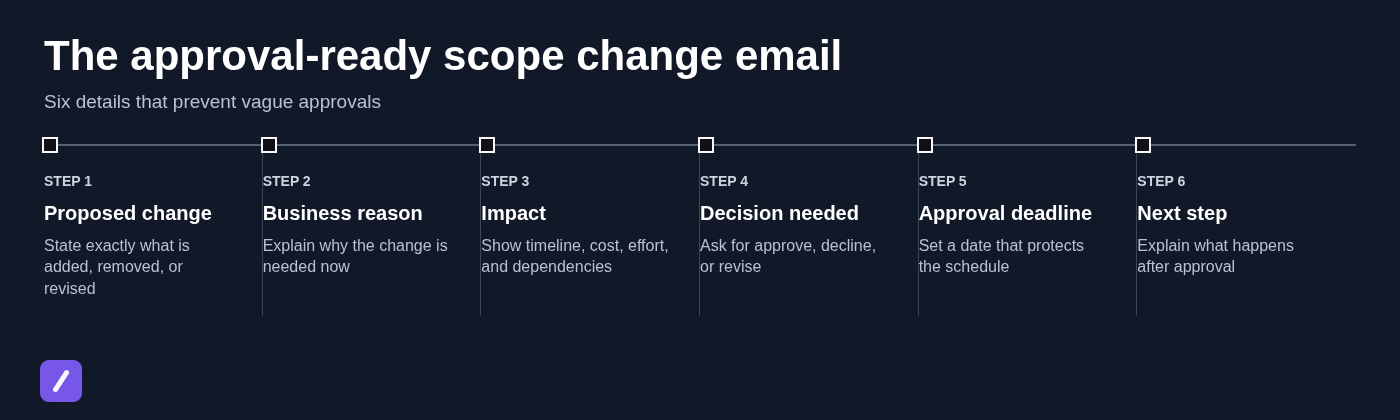
- Proposed change: What will be added, removed, or revised?
- Business reason: Why is the change needed now?
- Impact: What happens to budget, schedule, effort, quality, or dependencies?
- Decision needed: Are you asking the recipient to approve, decline, or choose an option?
- Deadline: When is a decision needed to avoid affecting the plan?
- Next step: What will happen once a decision is made?
Scope change request email template
Use this template when you need a client, stakeholder, sponsor, or internal manager to make a clear decision. Replace the bracketed fields, remove anything that does not apply, and keep the final request explicit.
Subject line options:
- Approval requested: [Project name] scope change - response needed by [date]
- Decision needed: [Change ID or change name] for [Project name]
- Request to approve [proposed change] - impact to [timeline/budget]
Email template:
Hi [Name],
I am requesting approval for a proposed change to the approved scope of [project name].
Proposed change: [State exactly what is being added, removed, or revised.]
Reason for the change: [Explain the business need, new information, client request, risk, or dependency driving the request.]
Impact: [State confirmed or estimated impact to timeline, cost, effort, resources, quality, and/or dependencies. Identify assumptions if applicable.]
Recommended approach: [State the option you recommend and why.]
Please reply by [date and time, if necessary] with one of the following:
- Approve: Proceed with the proposed change.
- Decline: Continue with the currently approved scope.
- Revise: Request changes to the proposal before approval.
If approved, [team or owner] will [update the project plan/change log/contract documentation] and begin [next implementation step] on [date or condition]. If a decision is delayed beyond [date], [state the practical schedule or delivery consequence].
Thank you,
[Name]
[Role]
How to write the request step by step
Write the request in the same order an approver needs to think: identify the change, explain the context, quantify the impact, offer options if there is a real choice, and ask for a decision. Do not make the recipient reconstruct the project history from old threads.
Keep the language neutral. Scope changes happen because requirements evolve, dependencies shift, assumptions prove wrong, or a stakeholder identifies a new need. Avoid blame-heavy phrasing such as "because the requirements were unclear" unless resolving that issue is itself part of the decision.
Professional wording is usually precise rather than overly formal. Phrases such as "proposed revision," "requested addition," "change to the approved scope," and "impact to the approved timeline" make the situation clear without implying that the work is already authorized.
Write a subject line that signals an approval decision
Your subject line should tell the recipient that action is needed. Include the project name, change identifier when your team uses one, and a deadline when timing matters.
- Approval requested: Website launch - add accessibility review by May 14
- Decision needed: CR-07 - revised data migration scope
- Client approval requested: Additional product onboarding guide
Avoid subjects such as "Quick question," "Update," or "Project change." Those make a decision email easy to overlook and difficult to find later.
Describe the change against the approved baseline
Explain the difference between what was approved and what is now proposed. The approver needs the delta, not a full retelling of every project detail.
For example: "The approved scope includes five product pages. The requested addition is two regional landing pages using the same approved design system." That is much clearer than saying, "We need to do more website pages."
Put detailed requirements, specifications, estimates, or marked-up documents in a linked or attached file when they are too long for the email. The email should summarize the decision; it should not become a hard-to-read specification document.
State impact in decision-ready terms
Impact should be concrete enough to support a choice. Include only the categories that matter: timeline, budget, effort, staffing, quality, technical dependencies, or delivery risk.
Separate facts from estimates. For example, "The vendor review adds a confirmed five-business-day dependency" is different from "We estimate an additional 12 to 16 hours of design effort, subject to approval of the final requirements." That distinction makes your request more credible.
If the impact is uncertain, say what must happen to refine it. A request for discovery work may be appropriate before asking for approval of a larger implementation change.
Ask for approval with a clear deadline
Ask for a specific response, not a vague indication of support. "Please reply 'Approved' by Thursday, May 14, to authorize this change" creates a usable written record.
You can explain the consequence of delay without sounding threatening: "To retain the June 30 launch date, we need a decision by May 14. After that date, the launch may move by one week." That is useful scheduling information, not pressure.
If a decision is delayed, send a concise polite reminder email that repeats the requested decision and the practical consequence of waiting. A simple email approval is often enough for small internal changes or when the project agreement permits it. Use a formal sign-off, change order, or contract amendment when the change affects contractual commitments, fees, regulated work, or established governance requirements.
Examples for common scope change situations
The structure stays consistent, but the emphasis changes depending on who requested the change and who must approve it. A client needs clarity on value, cost, and delivery. Internal stakeholders often need clarity on capacity, risk, and tradeoffs.
Example: Requesting client approval for an added deliverable
Subject: Approval requested: Add product onboarding guide to Q3 launch scope
Hi Maya,
Following our discussion, we are requesting approval to add a downloadable product onboarding guide to the Q3 launch deliverables.
The approved scope includes the launch landing page, three email messages, and paid social creative. The proposed addition is a six-page PDF guide using the approved campaign messaging and visual direction.
The estimated fee for this addition is $2,400, with an estimated 18 hours of writing and design work. To include the guide in the planned June 30 launch, we would need approval by May 14 and final product inputs by May 20.
Please reply with Approved to add the onboarding guide, Declined to proceed with the current scope, or Revise if you would like us to adjust the proposed deliverable.
Once approved, we will update the delivery schedule and share the content outline for review.
Best,
Jordan
Example: Informing stakeholders about a change and requesting a decision
Subject: Decision needed: Analytics integration impact to September release
Hi team,
The analytics vendor has confirmed that the requested event-tracking changes require an additional integration step that was not included in the approved release scope.
We recommend adding the integration work because it is needed to measure the new onboarding flow. The change is estimated at five development days and would move the September 18 release to September 25 if no other work changes.
Please choose one option by September 4:
- Approve the change: Add the integration and move the release to September 25.
- Defer the change: Release on September 18 without the new event tracking.
- Protect the date: Approve the integration and remove [lower-priority feature] from this release.
Once a decision is made, we will update the release plan and notify the affected owners.
Thanks,
Priya
Example: Requesting an internal change to timeline or resources
Subject: Approval requested: Additional QA capacity for CRM migration
Hi Alex,
I am requesting approval to assign one additional QA analyst to the CRM migration from October 7 through October 18.
The approved plan assumed that the data-mapping decisions would be complete by September 20. Those decisions are now expected on September 27, reducing the available testing window by five business days.
My recommendation is to add the QA resource for two weeks. This maintains the October 25 migration date and reduces the risk of incomplete validation. Without added capacity, we should move the migration to November 1 or accept a narrower testing scope.
Please approve the additional QA assignment by September 30 so we can reserve the resource. If approved, I will update the staffing plan and testing schedule.
Regards,
Sam

Choose the right level of detail for the recipient
Different readers need different levels of detail, but everyone needs the same core decision. Tailor the explanation without changing the underlying request.
An executive sponsor may need a two-sentence recommendation, the material cost or schedule impact, and the consequence of each option. A client may need deliverables, fee, timing, and any revised acceptance criteria. Delivery teams may need requirements, dependencies, owners, and implementation conditions.
Put the recommendation and material impact in the email body. Link or attach detailed estimates, requirements, technical notes, or change-log entries for people who need to validate the proposal.
Do not treat an approval signature or a one-word reply as the entire record. Capture what was approved, under what assumptions, who owns the next action, and whether additional documentation is required. Conditional approvals are especially easy to mishandle if the conditions are not recorded.
What to do after approval or rejection
Approval is the start of controlled implementation, not the end of the process. Record the decision, update the approved scope baseline and project plan, notify affected owners, and confirm when revised work will begin.
If the request is approved with conditions, repeat those conditions back in writing before the team starts. For example, a client may approve an added deliverable only if it does not change the launch date, or a sponsor may approve added engineering work only if another feature is deferred.
If approval is delayed, do not quietly treat silence as authorization. Follow up with the stated decision deadline and explain the resulting impact. If the request is rejected, confirm that the team will continue with the existing scope and remove any unapproved work from plans or task boards. For broader team communications after an approved operational change, an internal process change announcement template can help document what changes and when.
Email approval also does not replace a required contract amendment, purchase authorization, or formal change-control process. Complete the appropriate documentation before committing resources where those rules apply.
Avoid vague requests and accidental approval gaps
Most scope disputes are not caused by poor intentions. They happen because the change was described loosely, impact was assumed, or work began before a real decision was made.
- Do not present the change as already decided when approval is still required.
- Do not omit cost, schedule, or effort impact just because the estimate is uncomfortable.
- Do not ask "Does this look okay?" when you need authorization to proceed.
- Do not start revised work based on an informal conversation that has not been documented.
- Do not bury the requested decision in a long project update.
Before sending, confirm that the change is defined, the material impact is stated, the responsible owner is named, the decision requested is unmistakable, the deadline is included, and the relevant records will be updated after the response.
Send a scope change request that is easy to approve
A strong scope change request email gives stakeholders enough context to decide without making them search through project history. State the proposed revision, show the real tradeoff, request a specific decision, and document what happens next.
If the request follows a proposal or client deliverable, a reusable proposal follow-up email template can help keep the approval conversation organized. If you send these messages regularly, save your approved wording, follow-up messages, and decision-confirmation replies as reusable snippets in SnipFlux. Consistent language makes it easier to send clear requests quickly while preserving a reliable approval trail.