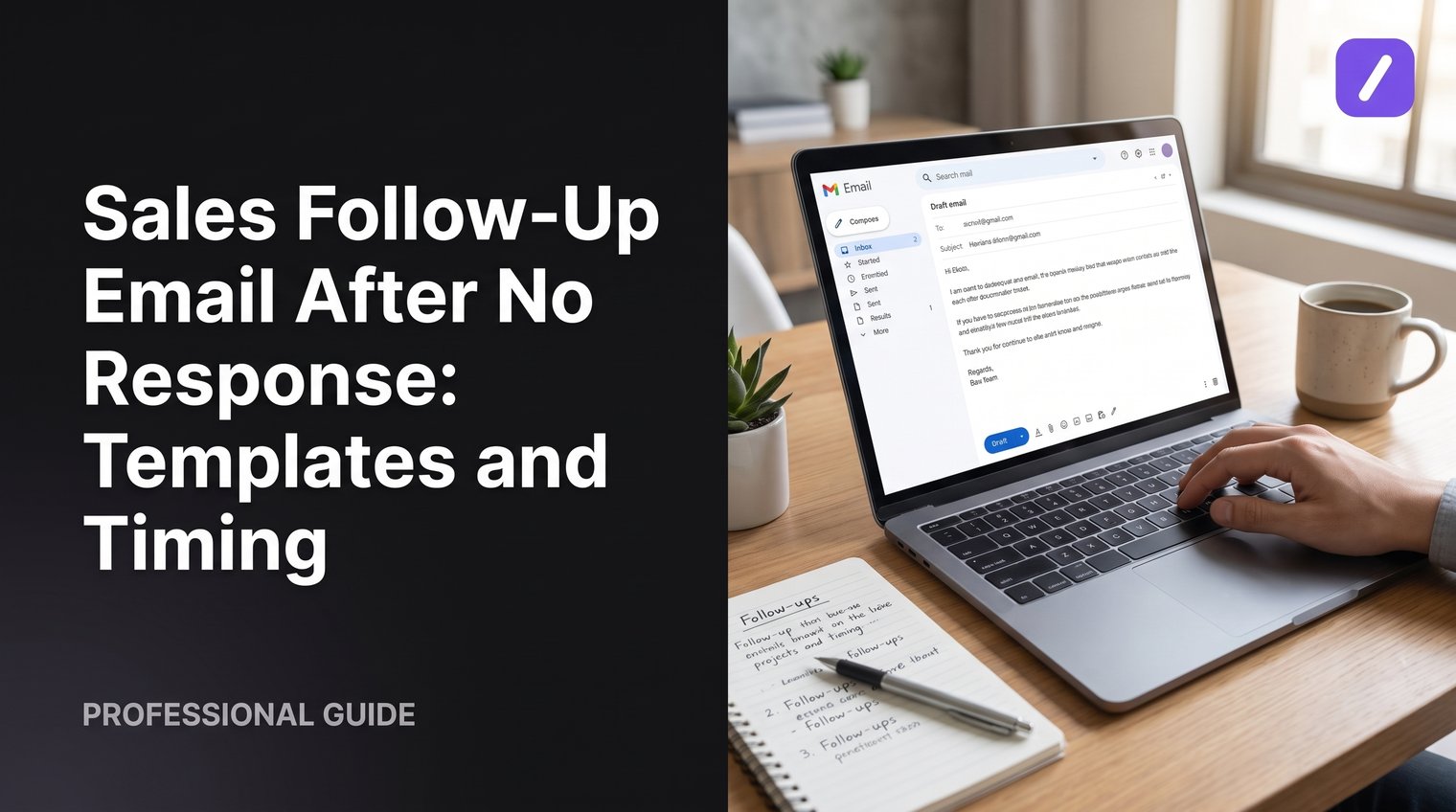
A sales follow-up email after no response should be short, relevant, and easy to answer. Wait a few business days, remind the prospect why the conversation matters, then ask for one clear next step rather than sending a vague "just checking in" note.
Silence rarely means an automatic no. It often means your email arrived during a busy week, lacked a clear priority, or asked the recipient to do too much. The templates below help you follow up without sounding pushy.
The reusable sales follow-up email template after no response
A polite follow-up works when it adds a useful reason to reply, preserves the original context, and makes the response low effort. For most B2B sales conversations, use this as a starting point and customize the bracketed lines before sending.
Copy-and-paste template
Subject: [Topic] - worth revisiting?
Hi [First name],
I wanted to follow up on my note about [original topic]. You mentioned or may be focused on [relevant priority], and I thought [specific value point] could be useful.
Would it make sense to explore this now, or should I reconnect in [month/quarter]?
Best,
[Your name]
This works as a simple follow-up email sample because it gives the recipient enough context without forcing them to reread a long prior message. The question also creates an easy choice: engage now or defer the conversation.
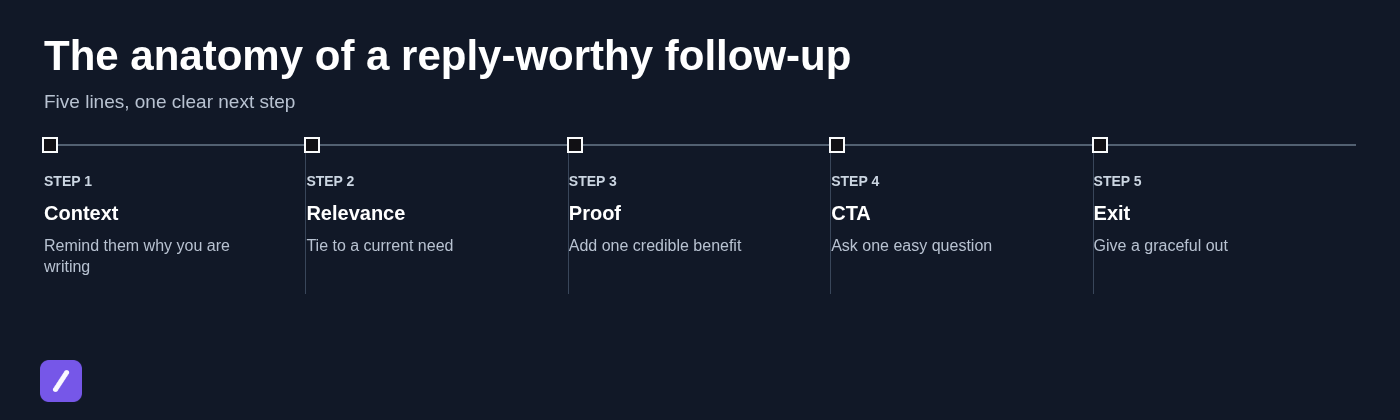
Why this follow-up works when a prospect is silent
Silence is ambiguous. A prospect may be interested but overloaded, comparing priorities, waiting for input from colleagues, or simply unsure why replying is worth their time.
That is why "Just checking in" performs poorly as a sales follow-up. It gives the buyer work to do: they must remember your earlier email, decide whether it matters, and invent a response. A useful follow-up does the opposite by restoring context and presenting one reason to respond.
Keep the note brief, but make it specific. Instead of saying your product "helps teams work better," connect it to a likely outcome: reducing handoff delays, shortening proposal turnaround, or standardizing customer replies. Then make one request, not a menu of meeting links, attachments, and questions.
When to send a follow-up email after no response
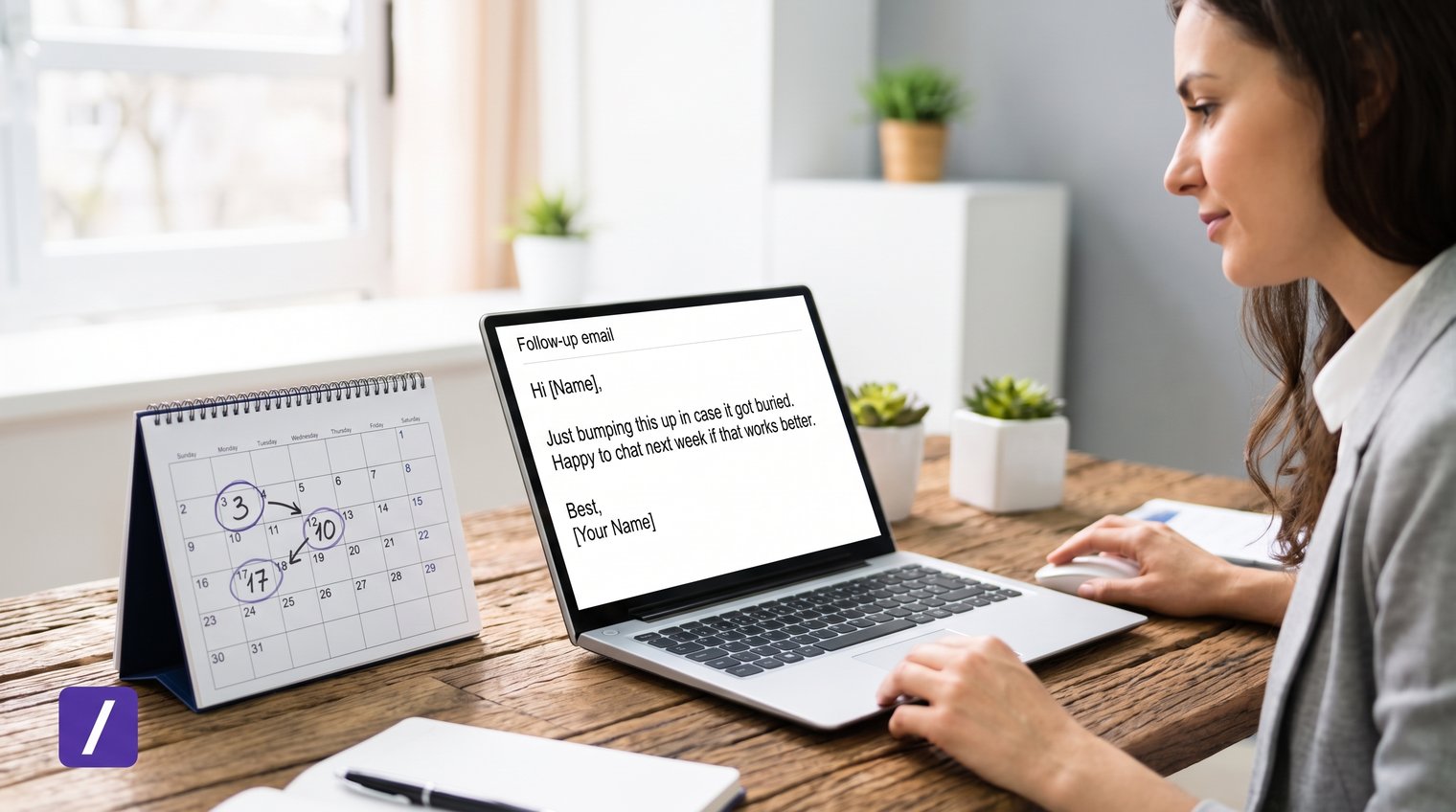
For an initial sales email, wait about 3 to 5 business days before following up. That gives the recipient time to see the message without allowing the conversation to go cold.
The right timing depends on the buying context. Wait longer after a complex proposal, during holiday periods, or when the prospect has explicitly said they will revisit the issue at a future date. Follow up sooner only when there is a real deadline, such as an event, contract date, or time-sensitive project.
It is not rude to send a follow-up email after no response when the message is respectful, paced, and relevant. Daily reminders are not persistence; they are usually noise. A few well-spaced touches with a clear reason to reply are more professional and more effective.
A practical follow-up cadence
- First follow-up: 3 to 5 business days after the initial email. Reintroduce the topic and connect it to one useful outcome.
- Second follow-up: About one week later. Share a different reason to engage, such as a relevant use case, resource, or question about priorities.
- Final touch: Another 7 to 10 business days later. Close the loop politely and offer a simple defer, decline, or referral option.
Do not send the same email three times with slightly different wording. Each touch should earn its place by offering a new angle or reducing the effort needed to respond. For more wording ideas, see these polite reminder email template examples.
How to personalize the template in under two minutes
Fast personalization is not about adding a generic compliment. It is about showing that your reason for writing fits something real about the buyer's role, company, or prior interaction.
- Reference the trigger: Mention the prior call, inbound inquiry, event conversation, shared resource, or public company update.
- Name the likely priority: Tie the message to a stated pain point or a plausible operational goal.
- Add a relevant proof point: Use a concrete capability, outcome, or customer example you can support.
- Tailor the CTA: Ask a question that fits their stage in the buying process.
For example, if a company has announced expansion into a new region, you might ask whether standardizing its support handoffs is part of the rollout plan. If a prospect previously mentioned slow quote approvals, ask whether that is still a priority this quarter. Do not pretend you have a deep relationship based on a single LinkedIn post or copied company description.
Choose a CTA that is easy to answer
The best follow-up CTA is usually a yes-or-no question or a simple choice. Avoid asking the prospect to explain their entire decision process in an email.
- "Is reducing handoff time still a priority this quarter?"
- "Would Tuesday or Thursday work for a 15-minute walkthrough?"
- "Should I send a revised scope for the smaller team first?"
- "Would it be better to revisit this after your planning cycle?"
One question is enough. If the prospect replies, you can move the conversation forward from there.
Templates for common sales follow-up situations
The right follow-up depends on where the buyer is in the sales process. A prospect who requested a demo needs a different prompt from someone who is reviewing pricing or deciding whether the problem is worth solving.
Product demo follow-up email template
Subject: [Use case] walkthrough this week?
Hi [First name],
Following up on the walkthrough for [use case]. Based on [their team/need], I think the most useful area to cover would be [relevant outcome or workflow].
Would Tuesday at [time] or Thursday at [time] be better for a 15-minute demo?
Best,
[Your name]
Replace the use case and outcome with something tied to the prospect's stated need or a reasonable inference from their role. Do not send a generic product tour invitation if they have already told you what they need help with.
Proposal follow-up email template
Subject: Questions on the [project/product] proposal?
Hi [First name],
I know proposals often need time for internal review, so I wanted to check whether any questions have come up on the [pricing, scope, or timeline] I sent over.
Is the main open point pricing, implementation scope, timing, or stakeholder approval?
Best,
[Your name]
This gives the buyer useful categories to choose from and may surface the real objection. It is better than asking whether they have "had a chance to review," which can sound like a demand for an update. For additional wording options, see this proposal follow-up email template guide.
Sales qualification email template
Subject: Is [business problem] on your radar?
Hi [First name],
I reached out because teams like yours often run into [specific business problem] when [relevant trigger or growth stage]. Is that something [Company] is working on this year?
If it is not relevant, no need to reply and I will close the loop.
Best,
[Your name]
Early outreach should confirm fit before pushing for a meeting. A graceful opt-out makes the message less intrusive and helps protect your sending reputation.
Simple follow-up email sample for a warm lead
Subject: Picking up from [event/conversation]
Hi [First name],
It was great speaking with you at [event] about [topic]. You mentioned [priority], and I wanted to see if a short conversation next week would be useful.
Would [day] or [day] suit you?
Best,
[Your name]
Warm leads do not need a lengthy recap. Reconnect the email to the prior interaction, name the next step, and make scheduling simple.
Subject lines that earn an open without sounding pushy
Your subject line should help the recipient recognize the topic, not trick them into opening. In many cases, keep the original email thread because it preserves context and makes your follow-up feel like a continuation rather than a new pitch.
- [Topic] - worth revisiting?
- Quick question about [priority]
- The [resource/template] I mentioned
- Next step for [project or use case]?
- Should we revisit [topic] in [month]?
Start a new subject line when your follow-up introduces a genuinely different, relevant reason to engage. Avoid vague subjects such as "Following up," false urgency, or clickbait. A prospect should understand the email's purpose before opening it.
What to avoid in a no-response sales follow-up
Most weak follow-ups fail because they are too vague, too soon, or too demanding. The goal is to reduce friction, not make the recipient feel guilty for being busy.
- Leading with "just checking in": Replace it with a reason for writing and a useful question.
- Writing a long recap: Include only enough context to refresh their memory.
- Following up too quickly: Give the prospect a reasonable window unless there is a genuine deadline.
- Adding multiple asks: Do not request a meeting, feedback, a referral, and document review in one message.
- Using accusatory language: "Did you see my last email?" can sound like a reprimand. Try "I wanted to revisit [topic] in case it is timely."
- Continuing without a business reason: Respect opt-outs, explicit noes, and repeated silence after a reasonable sequence.
Persistence only helps when the message remains relevant. Once you have exhausted credible reasons to follow up, stop rather than turning a potential future buyer into someone who avoids your name in their inbox.
If the prospect still does not respond
Send one final low-pressure email, then close the active outreach unless there is a clear reason to reconnect later. A final touch should make it easy to decline, defer, or point you to the right person.
Subject: Close the loop on [topic]?
Hi [First name],
I have not heard back, so I will close the loop for now. Should I reconnect in [month/quarter], speak with someone else about [topic], or assume this is not a current priority?
Best,
[Your name]
If you move the lead into a nurture path, do so only when your sales process, the relevance of future content, and any permission requirements support it. Nurture is not a reason to keep sending generic reminders indefinitely.
Make consistent follow-ups easier to send
Effective follow-ups are simple: wait an appropriate amount of time, personalize one useful reason to reply, and ask for one clear next step. The templates should save time, not replace judgment about the account, deal stage, and buyer's priorities.
Save approved versions as reusable snippets so you can insert the structure quickly and spend your time adapting the lines that actually need personalization. SnipFlux can store follow-up templates and insert them with shortcuts across Chrome, macOS, and Windows. You can also save a consistent sign-off with a reusable Gmail email signature.
SnipFlux
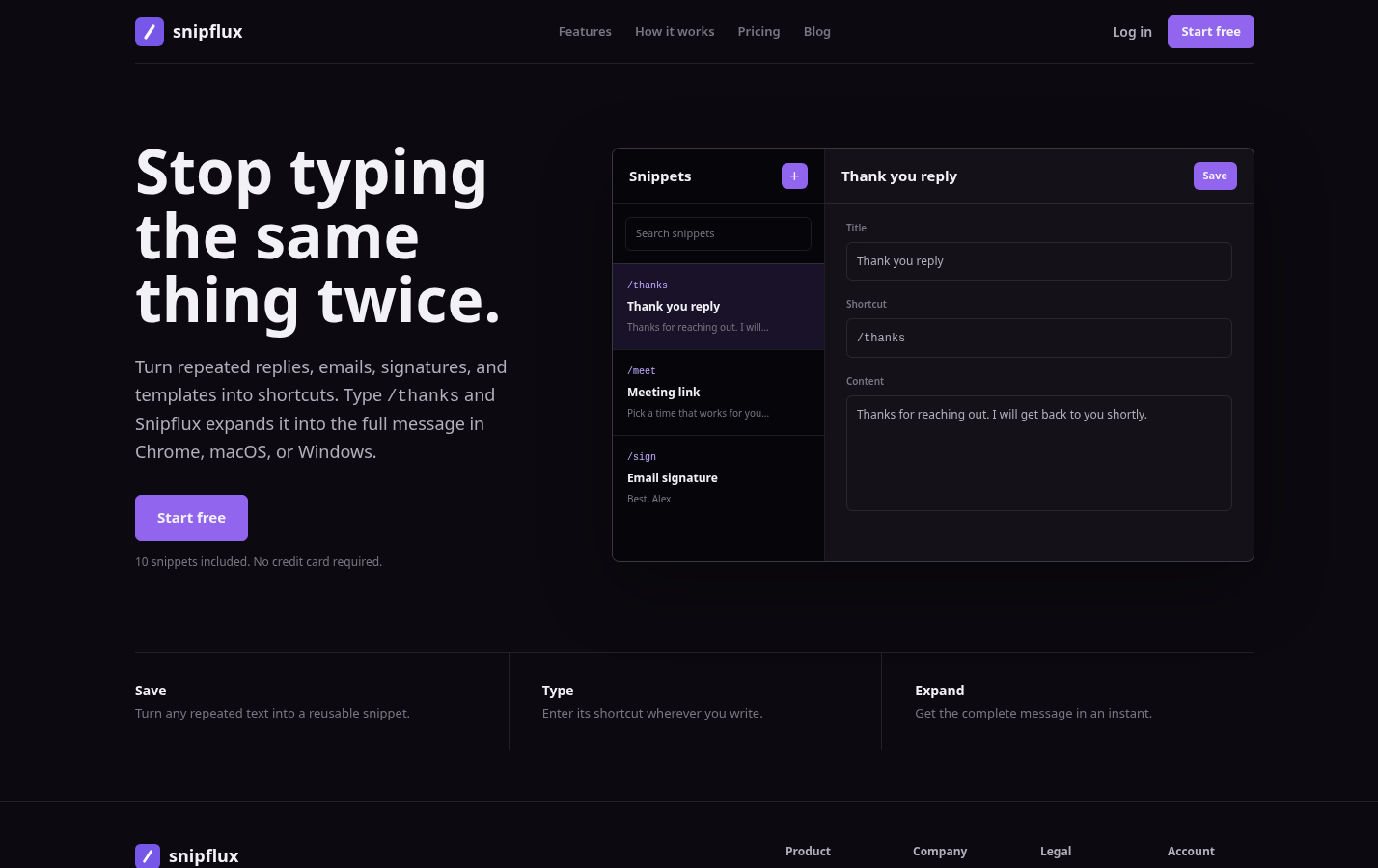
SnipFlux is best for sales teams and individual sellers who repeatedly use reliable follow-up structures, scheduling prompts, proposal check-ins, and signatures. Save a template under a memorable shortcut, insert it in a supported writing field, and customize the prospect-specific context before sending.
Its value is speed and consistency, not automated outreach or deal management. Choose it when your bottleneck is repeatedly typing approved text across Chrome, macOS, and Windows; use your CRM or sales engagement process for contact history, sequencing, and pipeline decisions.