A reference request can feel routine until you are staring at a blank reply and wondering how much to say. Too little detail is unhelpful; too much confidence about work you did not directly observe can put both you and the candidate in an awkward position.
A strong reference request response does three things at once: it answers the request promptly, makes your relationship to the candidate clear, and stays firmly within what you can honestly support. The examples below apply to professional, employment, academic, and character references. They are for responding to a request, not for writing an unsolicited recommendation letter.
A fast, useful reference response starts with a clear boundary
The best reference is not necessarily the longest or most enthusiastic one. It is the one a recruiter, hiring manager, admissions contact, or landlord can interpret correctly. Start by identifying what you know firsthand: how you know the person, when you worked or studied together, and which responsibilities or qualities you directly observed.
That boundary protects everyone involved. A former manager may be well placed to discuss a candidate's reliability, communication, and performance on a project. A colleague may be able to describe collaboration but not overall performance ratings. A family friend can speak to character, but should not make claims about professional competence they have never seen.
Be especially careful with broad statements such as "one of the best employees I have ever managed" or "guaranteed to succeed." If you cannot attach a claim to real experience, remove it. A measured, specific response carries more weight than generic praise.
The reference-request response workflow: from inbox to a sendable reply
Consider a representative situation: a former manager receives a recruiter email asking for a reference for a past team member. The manager remembers the candidate as dependable but has not worked with them for two years and did not oversee every part of their role. A quick response is appropriate, but a sweeping endorsement would not be.
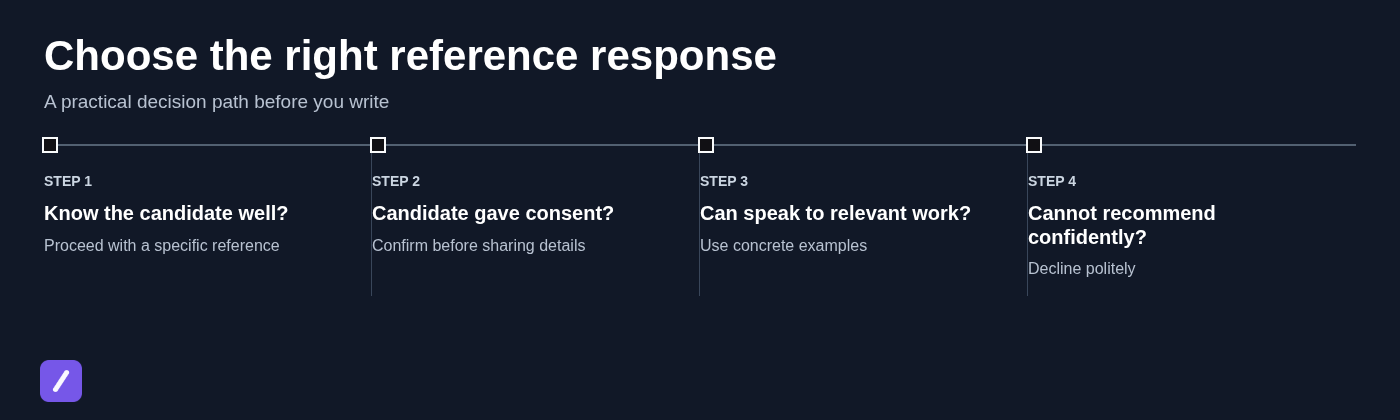
Before drafting, the manager should confirm that the candidate gave permission for the reference. Then identify the relationship and scope: former manager, team lead, professor, colleague, or personal acquaintance; dates of contact; and the work or conduct personally observed.
From there, choose the right response type:
- Accept and provide a detailed reference when you know the candidate well and can offer relevant firsthand examples.
- Provide a limited factual reference when you can verify title, dates, responsibilities, or other approved facts but cannot give a full evaluation.
- Decline politely when you lack sufficient knowledge, do not feel able to recommend the person, or cannot comply with an organizational policy.
Finally, match the channel to the request. A recruiter may prefer a phone call. An admissions office may ask for a signed letter. A simple employment verification request may be answered through an approved HR process. Do not assume a detailed letter is wanted when a brief email confirmation will do.
Before and after: turning a vague reply into a credible reference
A weak response often sounds positive but gives the reader nothing they can use:
"[Candidate Name] was a great employee and would be an excellent addition to your team. They were hardworking, professional, and easy to work with. I highly recommend them."
The problem is not its tone. The problem is that it does not explain who is speaking, what they observed, or why the recommendation applies to the role.
A stronger version is more restrained and more useful:
"I managed [Candidate Name] on the [Team Name] team from [Month/Year] to [Month/Year]. In their role as [Job Title], I observed their ability to keep stakeholders informed, prioritize incoming requests, and follow through on time-sensitive work. For example, during [brief project or situation], they [specific action], which helped the team [specific supported outcome]. Based on that experience, I would be comfortable recommending them for roles that require [relevant strengths]."
This version establishes the relationship, identifies relevant strengths, and offers evidence without inventing performance metrics or claiming knowledge beyond the writer's experience. It also gives the requester a natural opening to ask focused follow-up questions.
Reference request response templates for the situations that matter
Use these as starting points, not fill-in-the-blank endorsements. Replace every bracketed field with accurate information, remove anything you cannot support, and adapt the level of detail to the request.
1. Template: Accepting a reference request by email
Use this when you are willing to provide a reference but need to clarify the preferred format or timing.
Subject: Reference for [Candidate Name]
Hello [Requester's Name],
Thank you for reaching out regarding [Candidate Name]. I am happy to provide a reference based on my experience working with them as [your relationship] at [organization] from [time period].
Please let me know whether you would prefer a written response, a phone call, or a completed reference form. I am available [availability window], and you can reach me at [email address] or [phone number].
Best,
[Your Name]
[Title, if relevant]
[Contact Details]
2. Template: A detailed professional reference response
Use this for an employer or recruiter when you can speak directly about the candidate's work. Choose two or three strengths that genuinely match the role rather than listing every positive adjective you can think of.
Hello [Requester's Name],
I am pleased to provide a reference for [Candidate Name]. I worked with [them] as [your relationship] at [organization] from [month/year] to [month/year]. During that time, [Candidate Name] served as [job title] and was responsible for [relevant responsibilities].
Based on my firsthand experience, [Candidate Name] was particularly strong in [strength 1], [strength 2], and [strength 3, if applicable]. For example, when [brief situation or project], [they] [specific action or contribution]. I observed that [brief, supportable result or quality demonstrated].
[Candidate Name] communicated effectively with [customers, colleagues, stakeholders, or other relevant group] and approached [relevant type of work] with [observed quality, such as care, consistency, or sound judgment]. I would be comfortable recommending [them] for a role requiring [skills or responsibilities relevant to the opportunity].
Please feel free to contact me at [contact method] if a conversation would be helpful.
Sincerely,
[Your Name]
[Title and Organization, if appropriate]
[Contact Details]
Do not turn this into a performance review. One specific example is usually more credible than several unsupported claims.
3. Template: A brief confirmation-of-employment reference
Use this when you can provide factual verification but are not providing an evaluative recommendation. If you are responding on behalf of an employer, follow your organization's reference policy and use its approved process.
Hello [Requester's Name],
I can confirm that [Candidate Name] was employed by [organization] as [job title] from [start date] to [end date/current date]. Their general responsibilities included [brief factual description, if permitted].
For additional employment verification or questions covered by company policy, please contact [HR contact or approved verification process, if applicable].
Regards,
[Your Name]
[Title]
[Contact Details]
Keep this response factual. Do not add opinions, compensation information, performance ratings, or reasons for departure unless you are authorized to share them and the information is appropriate to disclose.
4. Template: A character reference response
A character reference is not a substitute for a professional reference. Use it in a personal, community, volunteer, housing, or similar context where your direct knowledge of the person's conduct is relevant.
To [Requester's Name or "Whom It May Concern"],
I am writing in response to your request for a character reference for [Candidate Name]. I have known [them] for [length of time] through [relationship or context].
Over that time, I have observed [Candidate Name] to be [specific quality, such as dependable, considerate, or responsible]. For example, [brief firsthand example that demonstrates the quality].
I can speak to [Candidate Name]'s character based on this personal experience, though I cannot comment on [their] professional performance outside of what I have directly observed. Please contact me at [contact details] if you need clarification about our relationship or the information above.
Sincerely,
[Your Name]
[Contact Details]
5. Template: Declining a reference request professionally
Declining is often the responsible choice when you cannot give an informed reference. You do not need to justify the decision in detail or invite a negotiation.
Hello [Candidate Name],
Thank you for asking me to serve as a reference. I appreciate the request, but I do not believe I am the best person to provide the detailed reference this opportunity deserves.
You may want to contact someone who worked more closely with you on [relevant project, role, or time period], as they may be able to speak more directly to your experience.
I wish you the best with your application.
Best,
[Your Name]
If the request comes from a recruiter rather than the candidate, keep it even shorter: state that you are unable to provide a reference and, where appropriate, direct them to the candidate or an approved verification channel.
How to personalize a template without weakening it
A template should make the writing faster, not make the reference generic. Before sending, add five details that establish credibility without overreaching:
- Relationship: State how you know the candidate and your level of direct contact.
- Time frame: Include the period you worked, studied, volunteered, or interacted together.
- Relevant responsibilities: Name the work or context that connects to the current request.
- Observed example: Describe a real situation, action, or behavior you personally saw.
- Calibrated recommendation: Recommend the person for the kind of work or setting you can reasonably evaluate.
Review the job description or request before writing. If the role emphasizes client communication, choose an example of stakeholder updates or customer care. If it calls for organization, use an example involving priorities, deadlines, or dependable follow-through. The goal is relevance, not flattery.
Never fill a gap with invented accomplishments, remembered-but-unverified numbers, performance ratings, or personal details. If you do not recall a project well enough to describe it, leave it out and use another example.

What to include in a written reference - and what to leave out
Include information that is relevant, firsthand, and appropriate for the requester to receive. In most professional references, that means your relationship to the candidate, the time period, the work you observed, relevant strengths, and one or two concrete examples.
Leave out confidential company information, protected personal information, medical or family details, rumors, disciplinary matters you are not authorized to discuss, and claims you cannot verify. Consent matters, too: even when a candidate gives permission to use your name, confirm that they expect you to respond before sharing substantive information.
A reference response is also different from a formal recommendation letter. A response may be a short email or a recruiter call addressing specific questions. A recommendation letter is usually a more structured document, often addressed to a program, employer, or committee. Give the requester the format they asked for rather than automatically producing a formal letter.
Make the response easy to use in Word, PDF, or email
Email is often sufficient for a straightforward reference request, especially when a recruiter asks for a quick confirmation or a time to speak. Use a clear subject line such as "Reference for [Candidate Name]," write in short paragraphs, and include your name, role if relevant, and contact details.
If the requester asks for a signed document, prepare the response in Word or another editable document format first. Add the date, recipient details when available, a concise subject line, readable paragraphs, and a professional signature block. Export a PDF only when requested or when you need to preserve formatting.
Before attaching anything, check the requested format, deadline, and any employer policy. A polished PDF cannot compensate for a response that answers the wrong question or includes information you should not share.
Save your best responses as reusable snippets
If you regularly handle reference requests, keep approved versions of your acceptance reply, factual verification, detailed professional reference, and decline message in one place. Build each template with clear placeholders such as [Candidate Name], [Relationship], [Dates], and [Example], so you are prompted to personalize it rather than sending a canned response.
This approach is particularly useful for managers, HR-adjacent staff, professors, and team leads who need to respond promptly while maintaining consistent boundaries. Review saved templates periodically as policies or responsibilities change. The same workflow can also support other recurring replies, such as a negative feedback response template, a consultation response template, or a feature request response template.
SnipFlux
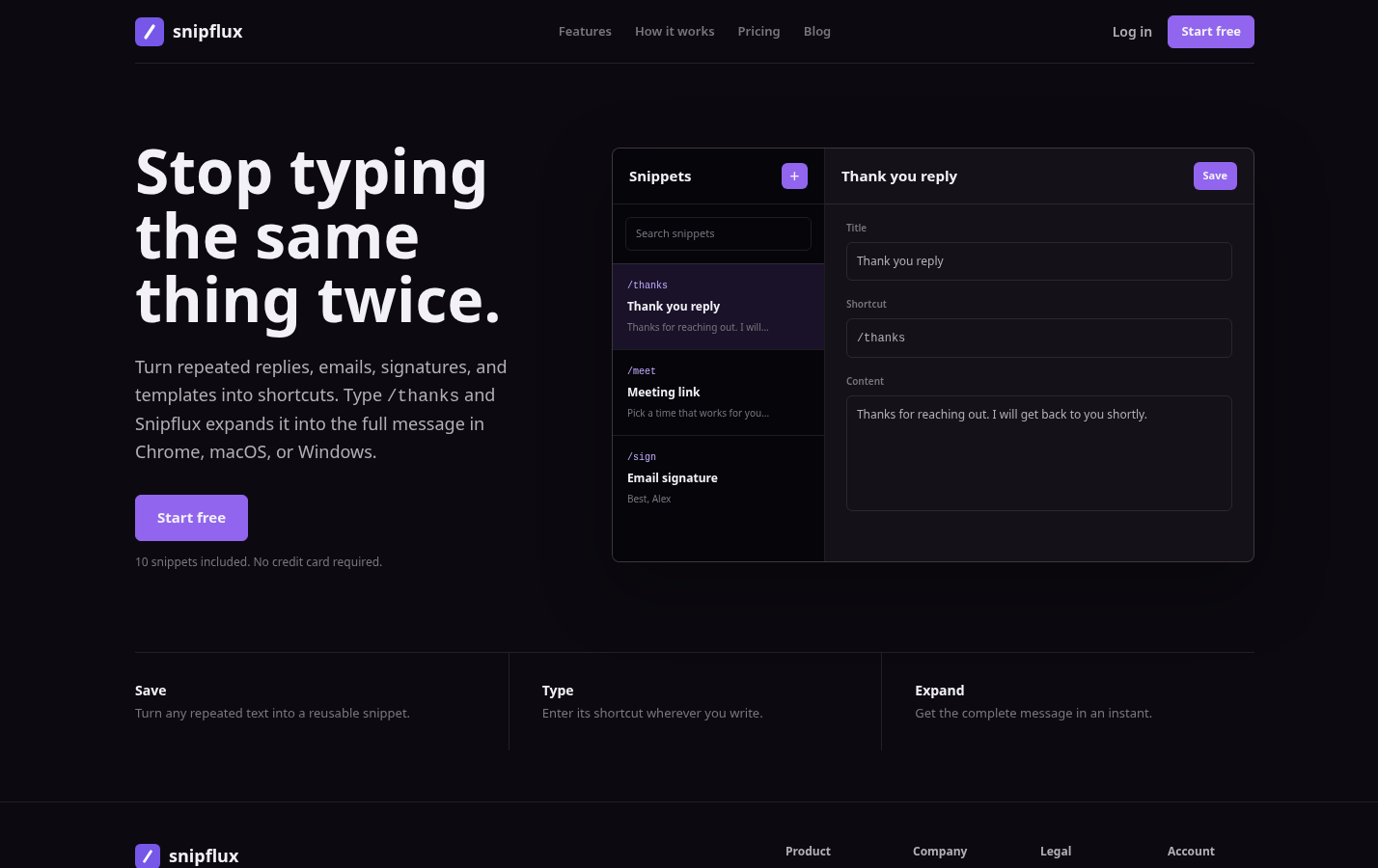
SnipFlux is useful when the recurring task is retrieving and inserting reusable text quickly. You can save reference-response templates as snippets, assign shortcuts such as /ref-accept or /ref-decline, and expand them in supported writing fields across Chrome, macOS, and Windows. Folders and labels can keep reference templates separate from routine email replies, while shared workspaces can help teams maintain approved language.
The important limitation is that shortcut expansion does not replace judgment. You still need to confirm consent, replace placeholders, verify every example, and follow the relevant policy before sending. It is best suited to people who repeatedly reuse carefully reviewed response structures rather than someone drafting a one-off reference from scratch.
Actionable checklist before you send a reference response
- Confirm the candidate has asked or consented to the reference.
- Verify what the requester needs: email, call, form, signed letter, or factual employment confirmation.
- State your relationship to the candidate and the relevant time frame.
- Use only examples, responsibilities, and strengths you can support firsthand.
- Remove sensitive, confidential, or unnecessary personal details.
- Check your employer's reference policy or approved verification process when applicable.
- Match the requested format, include accurate contact details, and proofread names and dates.
Respond with specificity, honesty, and the right level of detail
The strongest reference request response is tailored to the opportunity, but limited to what you genuinely know. A clear relationship, a relevant example, and a measured recommendation will serve the candidate better than vague praise or an overconfident claim.
For people who answer these requests often, saving approved versions of the core templates in SnipFlux can make the process faster and more consistent while leaving room for the personal details that make a reference credible.