A slow or vague reply can turn a promising consultation inquiry into a stalled conversation. The answer is not a longer sales message. It is a clear response that shows you understood the request, establishes the right next step, and is easy to send consistently.
A consultation response is the first message you send after someone asks about working with you. It acknowledges the inquiry, helps you assess fit, and moves the prospect toward a booking, a short qualification exchange, or an honest redirect. The examples below work for consultants, agencies, coaches, freelancers, and service businesses that want to reply quickly without sounding scripted.
The fast-response system: turn consultation inquiries into clear next steps
Most consultation inquiries do not need a custom proposal in the first reply. They need direction. A prospect who writes, "I'd like to learn more about your services," is usually trying to answer a few practical questions: Can you help with my situation? What happens next? How much effort will it take to find out?
A strong consultation response answers those questions without trying to close the entire sale in one email. It thanks the person, reflects what they shared, requests any essential missing detail, and offers one next action.
The goal is consistency, not robotic language. Your process can stay the same while the details that matter to the prospect - their goal, timeline, challenge, or referral source - are personalized.

Before and after: from vague reply to a consultation-ready message
Here is the kind of response that feels polite but creates work for the prospect:
Before:
"Thanks for reaching out. I'd be happy to chat. Let me know when you are available."
Nothing is technically wrong with it, but it leaves several questions unanswered. What would the conversation cover? Is the provider a fit for the work? Should the prospect send more information first? How should they suggest a time?
Now compare it with a more useful reply:
After:
"Hi Maya, thanks for getting in touch about improving your client onboarding process. I help service teams simplify the steps between a signed agreement and a successful kickoff. To see whether a consultation makes sense, could you share roughly how many clients you onboard each month and where the current process tends to break down? Once I have that context, I can suggest the best next step or send over a time to talk."
This version does not promise a result or force a calendar link into the conversation. It shows attention, narrows the missing information, and gives the prospect a simple path forward. Specificity and a low-friction next step matter more than a long pitch.
The five parts of an effective consultation response
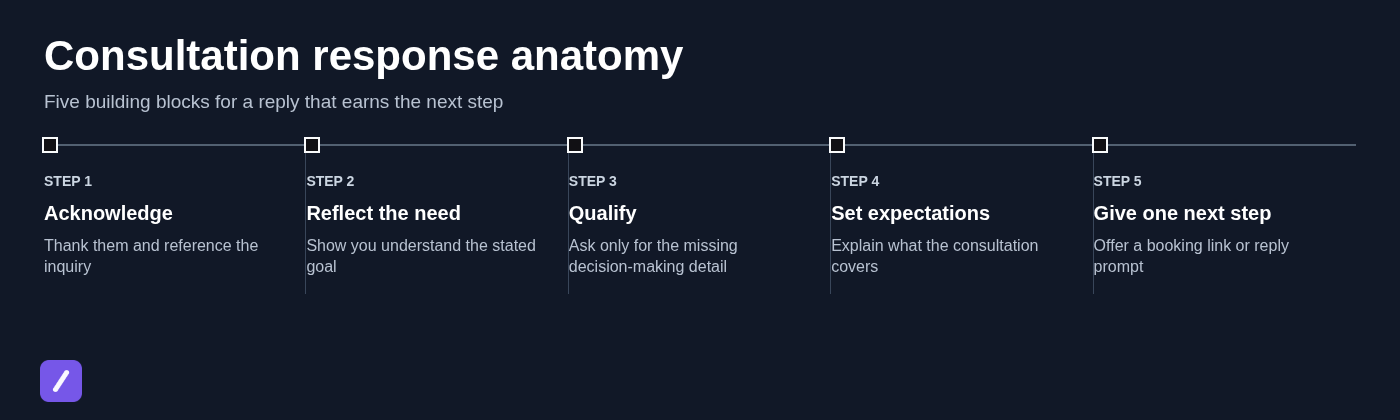
A reliable response has five building blocks. You can reuse most of the wording, but the parts that demonstrate attention should be tailored to the inquiry.
- Acknowledge the inquiry: Thank the person and mention the service, project, or topic they asked about.
- Reflect the need: Briefly restate their stated goal or challenge in your own words. This is often the most important personalization.
- Qualify with purpose: Ask only for the detail you need to decide whether to book, such as timeline, scope, budget range, audience, or current obstacle.
- Set consultation expectations: Explain what the conversation is for. For example, you may assess fit, clarify priorities, review options, or outline a recommended approach.
- Give one next step: Offer a booking link, ask them to reply with a specific detail, or direct them to a short intake form.
Use a helpful, confident tone. Avoid stiff phrases such as "Thank you for your esteemed inquiry," but also avoid overpromising before you understand the situation. A consultation response should sound like a capable person opening a useful conversation, not a pitch deck squeezed into an email.
Example 1: Reply to a general consultation inquiry
Use this when someone expresses interest but has not shared enough information to assess the project. They may ask about services, availability, pricing, or working together without explaining what they need.
Template
Hi [Name],
Thanks for reaching out about [service or type of support]. I'd be glad to learn more about what you are looking to accomplish with [project or goal].
To point you in the right direction, could you share [one or two essential details, such as timeline, current situation, or project scope]? If it looks like a good fit, we can schedule a [consultation type] to discuss priorities and next steps.
Best,
[Your name]
Illustrative example: operations consultant
Hi Daniel,
Thanks for reaching out about operations support for your growing team. I'd be glad to learn more about the processes you want to improve.
Could you tell me which part of day-to-day operations is causing the most friction right now, and whether you are looking for a short-term project or ongoing support? If it appears to be a fit, we can schedule a 30-minute consultation to discuss priorities and possible next steps.
Best,
Avery
This reply works because it does not make the prospect complete a full intake form before receiving any human acknowledgment. It asks for only the information needed to determine whether a consultation is worthwhile.
Example 2: Reply when the prospect describes a specific problem
When someone has already explained a clear challenge, reflect it back. That does not mean diagnosing the problem from a single message or promising a transformation. It means showing that you read what they wrote.
Template
Hi [Name],
Thanks for explaining what is happening with [specific problem]. It sounds like you are trying to [stated goal] while dealing with [key obstacle].
I would want to understand [targeted question one] and [targeted question two] before recommending an approach. Could you reply with those details? From there, I can let you know whether a consultation is the right next step and what we would cover.
Best,
[Your name]
Illustrative example: marketing strategist
Hi Priya,
Thanks for outlining the challenge with your campaign leads. It sounds like you are generating interest but are not seeing enough qualified conversations reach your sales team.
Before recommending a direction, I would want to understand which channels are currently producing leads and how your team defines a qualified lead. Could you send a brief note on those two points? Then I can suggest whether a consultation would be useful and what we should focus on.
Asking one or two targeted questions is often better than immediately sending a booking link. If the work may be out of scope, too urgent, too small, or unsuitable for your service, you need enough context to avoid a meeting that helps neither side.
Example 3: Reply after a referral or warm introduction
Warm introductions deserve a warmer acknowledgment, but they still require a defined process. A referral is not automatic fit, and an undefined conversation can waste the referrer's goodwill as easily as a cold lead can waste your calendar.
For related guidance on keeping the next step organized after a prospect moves forward, see this customer onboarding checklist email template.
Template
Hi [Name],
It's great to meet you, and thank you to [Referrer's name] for connecting us. I understand you are looking for support with [goal or challenge].
I would be happy to learn more about [relevant detail]. In a consultation, we can discuss your priorities, the scope of support you need, and whether my approach is a fit. You can book a time here: [booking link].
Best,
[Your name]
Illustrative example: executive coach
Hi Elena,
It's great to meet you, and thank you to Marcus for connecting us. He mentioned that you are preparing to step into a larger leadership role and want support as you make that transition.
In an initial consultation, we can discuss the situations you expect to navigate, the support you are looking for, and whether my coaching approach fits your goals. You can choose a time that works for you here: [booking link].
Best,
Renee
The referrer belongs in the acknowledgment, not at the center of the message. Shift quickly to the prospect's situation, define the consultation, and keep the next action clear.
Example 4: Reply when the consultation is paid or has a fee
A paid consultation should be stated plainly. Trying to conceal the fee until the last moment creates mistrust; overexplaining it can sound defensive. State the format, duration, price, and what the prospect receives.
Template
Hi [Name],
Thanks for reaching out about [topic]. Based on what you shared, a focused advisory session may be the best place to start.
The session is [duration] and costs [fee]. We will use the time to [what happens during the session], and you will leave with [deliverable, direction, or decision support]. If that format works for you, you can book here: [booking link].
Best,
[Your name]
Illustrative example: accessibility specialist
Hi Noor,
Thanks for reaching out about reviewing the accessibility issues on your customer portal. Based on your description, a focused advisory session would be a useful first step.
The session is 60 minutes and costs [fee]. We will review the main barriers you have identified, discuss priorities for remediation, and outline practical next actions for your team. If that format works for you, you can book a session here: [booking link].
Do not confuse a paid advisory session with a complimentary fit call. A fit call is usually brief and intended to decide whether to work together. A paid consultation provides standalone expertise, analysis, recommendations, or a working session. Name the difference clearly so the prospect knows what they are choosing.
Example 5: Reply when you are not the right fit
Saying no well is part of a professional consultation process. A vague rejection leaves the prospect stranded, while false optimism creates a poor engagement later. Be respectful, brief, and useful where you can be.
General not-a-fit template
Hi [Name],
Thanks for sharing more about [project or goal]. After reviewing what you need, I do not think I am the best fit for this particular project.
You may have better results with a provider who specializes in [relevant specialty or service type]. I appreciate you considering me, and I wish you success with [their goal].
Best,
[Your name]
Budget mismatch variant
"Based on the scope you described, the project would likely require a level of investment that may not align with the budget range you mentioned. Rather than set the wrong expectation, I think a provider with a smaller-scope offering may be a better match."
Out-of-scope variant
"The work you described falls outside my core area of practice. I focus on [your specialty], while this project would be better served by someone experienced in [needed specialty]."
Timing variant
"I am not able to take on a project within the timeline you need. I do not want to delay an important initiative by asking you to wait for availability I cannot confidently offer."
A good decline does not require a lengthy defense or a referral you cannot personally stand behind. Give a clear reason at a useful level, suggest a next direction when appropriate, and avoid promises you cannot make.
Build a consultation response template that still feels personal
The best template is not a giant script with every possible scenario squeezed into it. Start with a short core response, then keep versions for the situations you handle most often.
Save the repeatable language, and leave obvious fields for the details that should change:
- [Name]
- [Service or project type]
- [Stated goal or problem]
- [Referral source]
- [Qualification question]
- [Booking link]
- [Availability window]
Personalize the first sentence and the qualification question whenever possible. Those are the areas where readers can immediately tell whether you paid attention. The explanation of your consultation format, availability process, or paid-session terms can usually remain standard.
Before sending, use a short editing check:
- Is the person's name spelled correctly?
- Did I reflect the actual need rather than assume one?
- Are pronouns and company references accurate?
- Does the promised next step match the call to action?
- Does the booking or resource link work?
Use SnipFlux shortcuts to send consistent replies without copy-paste
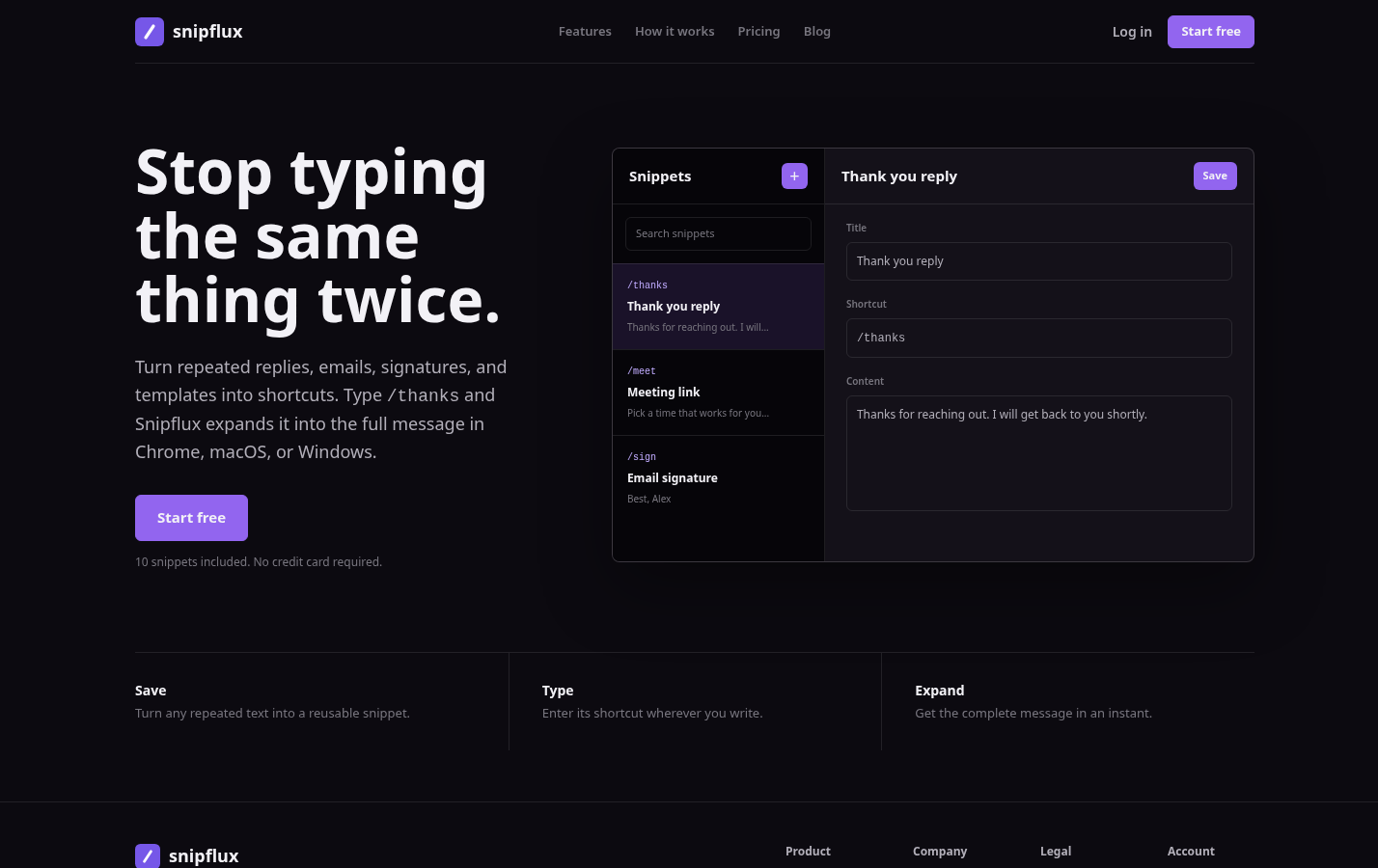
Templates only help when they are easy to retrieve in the moment. With SnipFlux, you can save common consultation responses as reusable snippets and assign shortcuts that expand into the full text while you write.
A practical naming system might look like this:
- /consult-general for broad service inquiries
- /consult-problem for inquiries that describe a specific challenge
- /consult-referral for warm introductions
- /consult-paid for paid advisory sessions
- /consult-notfit for respectful declines
Keep placeholders in each snippet where personal details belong. For example, type the prospect's name and a sentence acknowledging their situation first, then use the shortcut to insert the consultation structure. Edit the qualification question and call to action before sending.
This approach is more reliable than repeatedly searching through old sent messages or copying text from a separate document. Your standard wording stays consistent, while the parts that make the reply feel personal remain under your control.
A practical workflow for replying within your chosen response window
You do not need to answer every inquiry instantly, but you should decide what timely means for your business. For some teams, that may be the same business day. For others, it may be the next business day. The important part is having a standard you can reliably meet.
Use this repeatable sequence:
- Review the inquiry: Identify the stated goal, any missing decision-making details, and signs that the request is outside your scope.
- Choose the closest template: Start with the general, problem-specific, referral, paid, or not-a-fit version.
- Personalize two details: Add the person's name and reflect their specific goal, challenge, or context.
- Confirm the call to action: Ask for the missing information or provide one appropriate booking option.
- Send and track the next step: Make sure the prospect has a clear path to reply, book, or move on.
Avoid the consultation response mistakes that create friction
Generic acknowledgments: "Thanks for reaching out. How can I help?" forces the prospect to repeat themselves. Instead, reference the goal or issue they already mentioned.
Overly long questionnaires: A first reply should not feel like an application unless the service genuinely requires formal screening. Ask only for the missing detail that determines the next decision.
Unclear pricing language: If the first conversation is paid, say so. If it is a complimentary fit call, say what it is and what it is not. Ambiguity is not a sales strategy.
Multiple competing calls to action: Do not ask someone to book a call, fill out a form, review a brochure, and reply with three details in the same message. Choose the next action that best fits their level of readiness.
Calendar links without context: A booking link is convenient, but it should not arrive without an explanation of what the meeting is for. Give the prospect a reason to invest the time.
Each correction comes back to one principle: a consultation response should advance one decision - whether and how to begin a useful conversation.
Put the templates into a repeatable consultation-response routine
Choose the scenario-specific version that fits the inquiry, then save your most-used versions as SnipFlux shortcuts so they are available across Chrome, macOS, and Windows. For requests with formal requirements, a structured RFQ response template can help; after a consultation, these proposal follow-up email templates can help keep the opportunity moving.