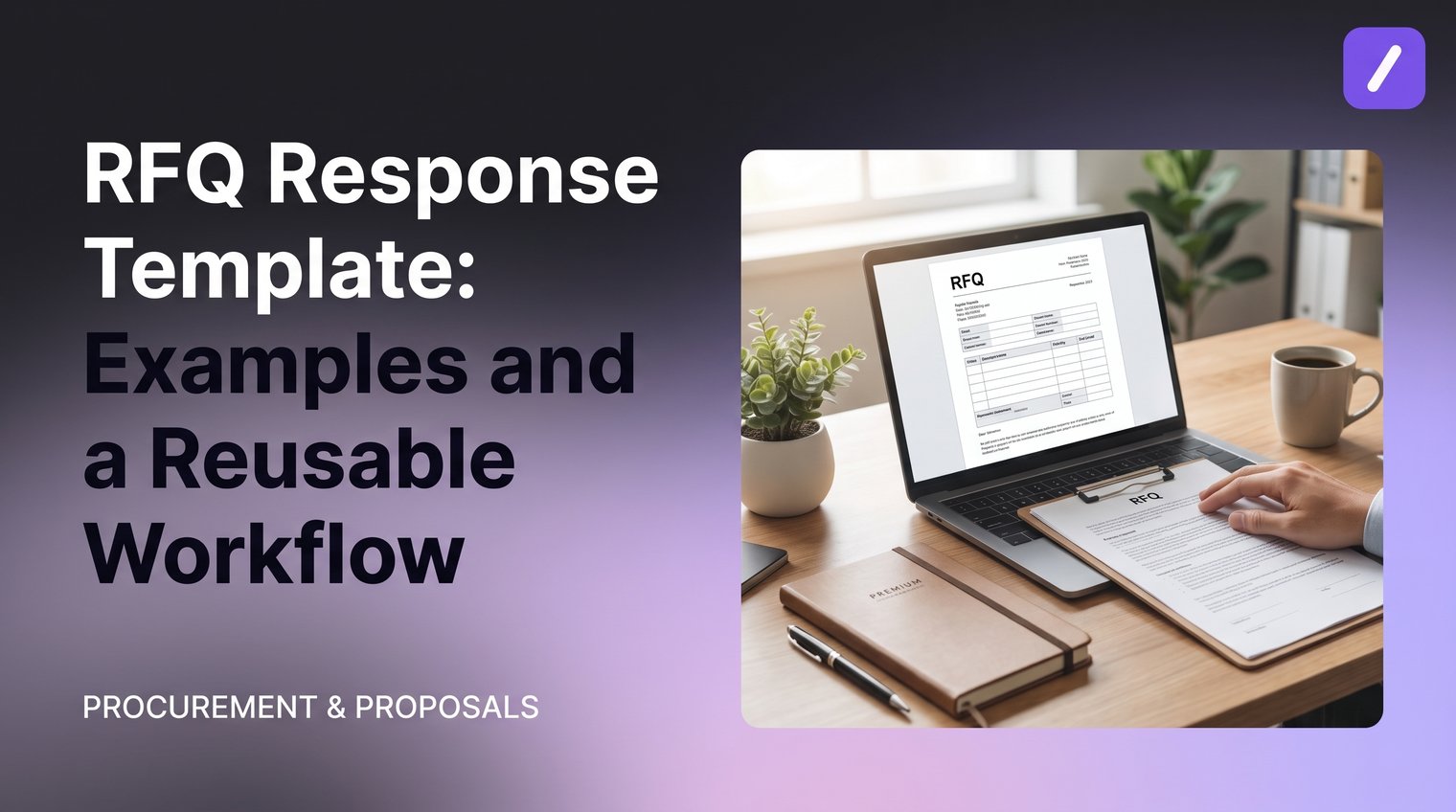
A vague quote does not just look unpolished. It creates extra work for the buyer, invites clarification emails, and makes your offer harder to compare against suppliers who answered the RFQ line by line.
A strong RFQ response template solves that problem without turning every quote into a lengthy proposal. The goal is simple: give the buyer a fast way to verify what you are offering, what it costs, when it can arrive, and what conditions apply.
A clear RFQ response helps buyers compare you - and move forward faster
Procurement teams often evaluate several quotations at once. If your scope is hidden in a paragraph, your freight is unclear, or your delivery date is implied rather than stated, the buyer has to interpret your response before they can compare it. That is where approvals slow down.
The best RFQ response is not a one-size-fits-all document. It is a repeatable system: use approved language for the details that remain stable, then map the quote to the buyer's exact requirements, quantities, dates, and commercial terms.
Think of the response as a decision document, not a sales brochure. Buyers should not have to hunt through a generic proposal to find the total price, lead time, exclusions, or next step.
What an RFQ response must answer before a buyer can approve it
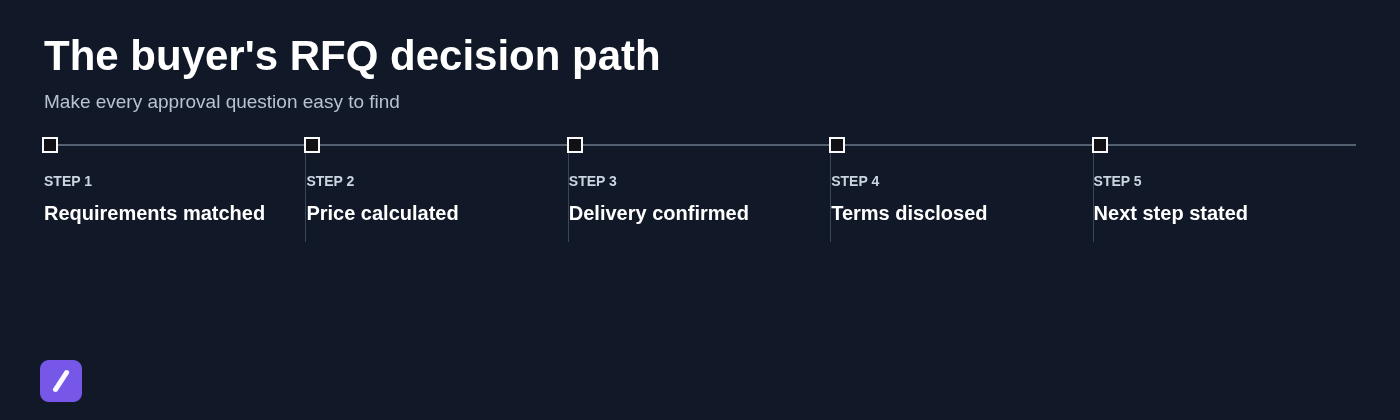
To reply to a request for quotation, first acknowledge the RFQ and confirm that you understand what is being requested. Then show exactly what you are quoting, the price basis, delivery commitment, commercial terms, assumptions, and any exceptions.
At minimum, a buyer should be able to answer these questions from your response:
- Which RFQ, project, and line items does this quotation cover?
- Does the quoted scope meet each stated requirement?
- What is the unit price, quantity, and total cost?
- Are freight, taxes, installation, or other charges included or excluded?
- What is the lead time, and when does it start?
- How long is the quote valid?
- What assumptions, dependencies, or deviations require buyer attention?
- What should the buyer do next?
An RFQ response is different from a sales proposal. A proposal may explain your approach, credentials, and value in detail; an RFQ response primarily answers the buyer's defined purchasing questions. A purchase order is different again: it is the buyer's authorization to buy, not your quote. Match the format requested in the RFQ rather than sending the document you prefer to create.
The reusable RFQ response template
Use the following as an email response or as the cover page for an RFQ response PDF. If the buyer specifies a portal, pricing workbook, signed form, or particular attachment structure, follow those instructions first and use this template to ensure nothing important is omitted.
Subject line, acknowledgement, and quote validity
Start with an identifiable subject line and a short acknowledgement. Make it easy for the recipient to connect your reply with the correct sourcing event.
Subject: RFQ [RFQ Number] - Quotation for [Project or Product Name]
Dear [Buyer Name],
Thank you for the opportunity to quote RFQ [RFQ Number] for [project, product family, or service]. We are pleased to provide our quotation for the requirements listed below. This quotation is valid through [date], subject to the assumptions and exceptions stated in this response.
Your primary contact is [name, title, email, phone]. Please send any technical or commercial questions to [contact method].
A quote-validity date matters because input costs, capacity, exchange rates, and freight conditions can change. Do not leave validity unstated and assume the buyer understands your standard policy.
Requirement-by-requirement scope confirmation
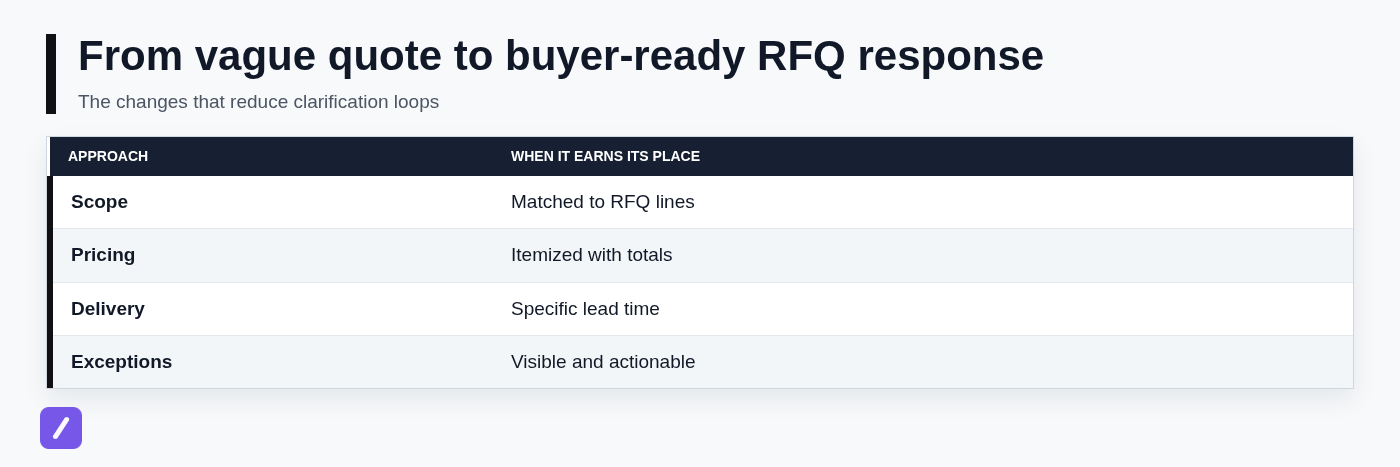
Mirror the RFQ's terminology and line-item order. Buyers should be able to compare your reply against their request without translating your internal product names or searching a differently organized document.
| Buyer requirement | Supplier response | Status | Clarification needed |
|---|---|---|---|
| [RFQ line or specification] | [Quoted model, service, or compliance statement] | [Included / Excluded / Option] | [Question or "None"] |
| [RFQ line or specification] | [Quoted model, service, or compliance statement] | [Included / Excluded / Option] | [Question or "None"] |
If you cannot meet a requirement exactly, say so directly. A visible exception is easier to evaluate than a quiet substitution that surfaces after the purchase order is issued.
Pricing, delivery, and commercial terms
Itemized pricing makes comparison faster and protects both parties from misunderstandings. Label estimates, optional items, and exclusions where the buyer will see them, not in a footnote after the total.
| Line | Description | Unit price | Quantity | Extended price | Lead time |
|---|---|---|---|---|---|
| [1] | [Item or service] | [$0.00] | [0] | [$0.00] | [Lead time] |
| [2] | [Item or service] | [$0.00] | [0] | [$0.00] | [Lead time] |
| Subtotal | [$0.00] | ||||
| Freight [included / excluded / estimated] | [$0.00] | ||||
| Taxes [included / excluded / as applicable] | [$0.00] | ||||
| Total quotation value | [$0.00] | ||||
Add payment terms, delivery terms, warranty coverage, and any relevant currency or Incoterms information. For delivery, state the trigger clearly: for example, "4-6 weeks after receipt of purchase order and approved drawings," rather than simply writing "4-6 weeks."
Assumptions, exceptions, and a precise next step
Assumptions are not a sign of uncertainty when they are specific. They tell the buyer what conditions underpin the price and delivery commitment.
Assumptions and exceptions: Pricing assumes [condition]. [Requirement] is excluded from this quotation and can be quoted separately upon request. Delivery timing is subject to [capacity, approved drawings, site access, or another stated dependency].
Close with a decision-oriented next step:
Please confirm acceptance of this quotation by issuing a purchase order referencing RFQ [RFQ Number]. If you would like us to revise [specified line or assumption], please reply by [date] so we can update pricing and lead time accordingly.
Example 1: A short email RFQ reply for a standard order
The following is a fictional, illustrative example. It fits a routine order where the buyer needs a prompt, scannable answer and has not requested a detailed pricing schedule.
Subject: RFQ 2026-184 - Quotation for Replacement Filter Cartridges
Dear Jordan,
Thank you for RFQ 2026-184. Northline Industrial Supply is pleased to quote the requested replacement filter cartridges for the Rivergate maintenance program.
| RFQ line | Description | Unit price | Quantity | Extended price | Lead time |
|---|---|---|---|---|---|
| 1 | Compatible filter cartridge, Model FC-220 | $84.00 | 40 | $3,360.00 | 7 business days after PO |
| Total | $3,360.00 | ||||
Freight is included for delivery to the address listed in the RFQ. Sales tax is excluded and will be applied where required. Payment terms are Net 30 from invoice date. This quotation is valid through October 18, 2026.
The quoted cartridge meets the dimensions and filtration rating specified in RFQ line 1. Please issue a purchase order referencing RFQ 2026-184 to proceed. Questions can be directed to Maya Chen at maya@example.com.
Regards,
Maya Chen
Northline Industrial Supply
The strength of this reply is not its length. It identifies the RFQ, confirms the item, shows the math, states the delivery basis, and tells the buyer exactly how to accept.

Example 2: A line-item RFQ response for a complex purchase
Complex purchases need more traceability. When specifications, optional components, engineering review, staged delivery, or multiple pricing lines are involved, an email-only total is rarely enough. A PDF attachment plus a spreadsheet pricing schedule is often the more practical submission, particularly when the RFQ asks for a completed pricing form.
Before: an ambiguous response that creates buyer follow-up
Here is a fictional example of the kind of response that looks fast but causes delays:
"We can supply the equipment package for $96,500. Delivery is approximately 10 weeks. Pricing includes the requested system. Let us know if you would like to proceed."
That response leaves the buyer with too many unanswered questions. Which requested components are included? Is commissioning part of the price? Does the total include freight? Is "approximately 10 weeks" a commitment, and from what date? A buyer comparing several suppliers may need to send follow-up questions before the quote can enter an approval workflow.
After: a buyer-ready response with traceable details
Now consider this structured excerpt for the same illustrative purchase.
RFQ reference: RFQ 2026-219 - Pump Skid Upgrade Package
Quote validity: Valid through November 7, 2026
Delivery basis: FCA supplier facility; 10 weeks after purchase order, approved submittals, and receipt of required buyer-furnished data
| RFQ requirement | Supplier response | Status |
|---|---|---|
| Line 1: Pump skid with specified motor rating | Model PS-480 skid with 15 kW motor, configured to stated operating range | Included |
| Line 2: Control panel with remote monitoring interface | Control panel included; Modbus TCP interface included | Included |
| Line 3: On-site commissioning | Not included in base package; optional field service line shown below | Exception / Option |
| Line 4: Delivery to buyer site | Freight quoted separately due to final site access and unloading requirements | Clarification required |
| Line | Description | Extended price | Lead time |
|---|---|---|---|
| 1 | Pump skid and motor package | $71,800.00 | 10 weeks |
| 2 | Control panel and interface configuration | $16,400.00 | 10 weeks |
| 3 | Documentation and factory acceptance test | $4,900.00 | Included with package |
| Optional | One-day on-site commissioning service | $3,400.00 | Scheduled after delivery |
| Base package subtotal | $93,100.00 | ||
Exception: The base package does not include on-site commissioning. The optional service line may be accepted with the purchase order or added later, subject to field-service availability.
Next step: Please confirm whether the buyer requires delivery to site and whether commissioning should be included. We will then issue a revised freight line and final commercial total.
The improvement is structural. Every requirement is traceable, totals are transparent, the exception is visible, and the buyer knows what decision or clarification is needed next. That is far easier to evaluate than a single unexplained number.
How to turn the template into a dependable response workflow
A good template is only useful if the team can complete it reliably. The usual breakdown happens when sales, technical staff, operations, and finance each contribute information in separate email threads, then someone assembles a final version under deadline pressure.
A more dependable workflow follows a clear sequence:
- Intake the RFQ: Record the RFQ number, due date, submission method, required forms, and buyer contact.
- Extract requirements: Turn specifications, line items, delivery requirements, and commercial conditions into a response matrix.
- Assign owners: Send technical questions to technical owners and price, freight, payment, and lead-time questions to the appropriate commercial owners.
- Validate the response: Check scope, arithmetic, terms, exceptions, attachments, and approval status before submission.
- Send in the requested format: Use the requested portal, email address, workbook, or RFQ response PDF format, and retain the final submitted version.
This approach prevents version drift. Instead of several people editing competing copies of the same response, the team works from a defined requirement list and one approved final document. Teams comparing reusable response tools may also benefit from this guide to canned response software and the workflows it supports.
Build a source-of-truth snippet library for repeated language
Many RFQ responses contain language that should not be rewritten from scratch: acknowledgements, quote-validity statements, payment terms, shipping language, warranty language, standard exclusions, and follow-up lines.
Store these approved blocks in a central library with descriptive names, such as "Net 30 payment terms," "freight excluded," or "lead time after approved drawings." This reduces typing and helps teams use consistent commercial language.
Consistency does not mean blindly pasting boilerplate. Every saved block must be checked against the RFQ before sending. A standard freight statement, for example, is wrong if the buyer has explicitly requested delivered pricing.
Use text shortcuts without making the reply feel templated
Shortcuts are useful for stable text, not for the details that make a quote credible. A team might use /rfq-ack for an acknowledgement, /quote-validity for the validity clause, and /rfq-terms for approved payment language, then tailor the scope matrix, prices, delivery dates, and exceptions manually. For a broader comparison of this workflow with reusable snippets, see text replacers versus reusable snippets.
SnipFlux is a cross-platform text expander and snippet manager that can insert approved response blocks in email, browser-based portals, and documents across Chrome, macOS, and Windows. It is useful when teams repeatedly enter the same vetted language but still need to build each RFQ response around buyer-specific requirements.
SnipFlux
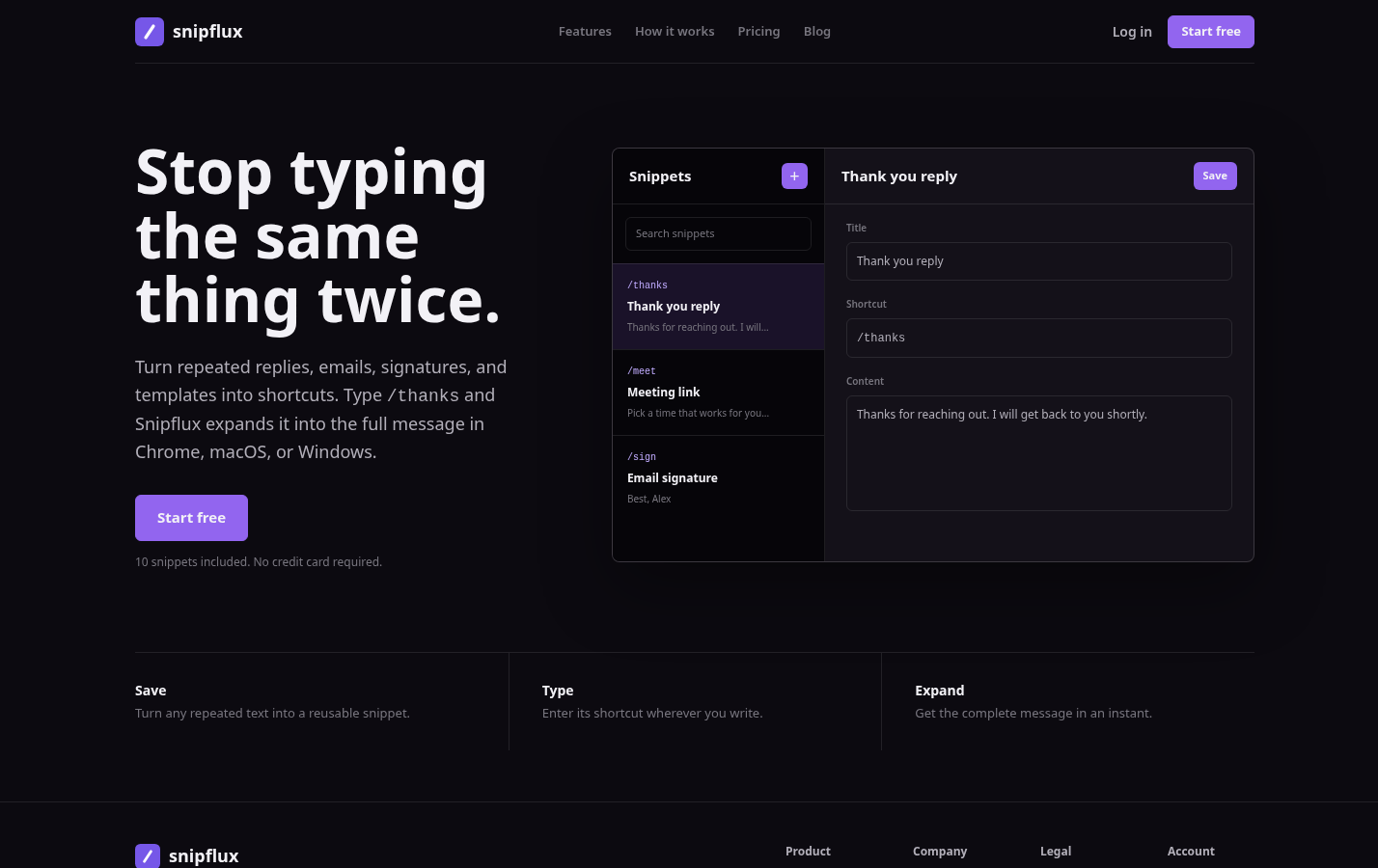
SnipFlux works best for teams and individuals who repeatedly type approved RFQ boilerplate and want it available through memorable shortcuts. A response writer can save a complete validity clause, standard warranty wording, or an acknowledgement email, then expand it with a shortcut such as /rfq-ack while drafting.
Its folders, labels, and shared workspaces are useful when a sales or operations team needs a maintained library instead of scattered personal documents. The meaningful limitation is that SnipFlux does not replace quote calculation, document approval, or technical review. It speeds up the reusable language layer; people still need to validate the specific scope, pricing, and commitments before submission.
Common RFQ response mistakes that slow approval
- Replying with only a total: A total without line-item scope forces the buyer to ask what is included. Prevent this with an itemized pricing table and a requirement matrix.
- Changing the buyer's line-item structure: Reorganizing the quote around your own catalog may make internal sense, but it creates comparison work for procurement. Preserve the RFQ sequence and cross-reference your part numbers where needed.
- Hiding exclusions: Burying freight, commissioning, installation, or taxes in fine print creates risk later. Put exclusions in a visible assumptions and exceptions section.
- Omitting quote validity: Without a validity date, pricing disputes become more likely if the buyer delays. Include a clear expiration date near the opening.
- Promising delivery without qualification: A lead time that ignores approved drawings, buyer-furnished information, capacity, or shipping conditions can become an unintentional commitment. State both the duration and its trigger.
- Ignoring submission instructions: A well-written quote can still be rejected or delayed if it misses a required form, signature, portal field, or attachment. Make submission instructions part of the final review.
A final pre-send checklist for your quote response template
Use this quality-control pass for an email response, a formal quote package, or an RFQ response PDF submission.
- RFQ number, project name, buyer contact, and due date are correct.
- Every RFQ line is addressed, cross-referenced, or clearly marked as excluded or requiring clarification.
- Unit prices, quantities, extensions, subtotals, and totals have been checked.
- Taxes, freight, currency, and optional charges are clearly identified.
- Lead times include the correct starting condition and any dependencies.
- Quote validity is stated as a specific date.
- Payment, delivery, warranty, and other commercial terms are included where requested.
- Assumptions and exceptions are visible and written in plain language.
- Required attachments, pricing schedules, certifications, and forms are included.
- The response follows the buyer's submission method and includes a precise next step.
Make every RFQ reply easier to compare and approve
Fast RFQ responses do not come from sending less information. They come from reusing approved language where it belongs and mapping every quote to the buyer's actual requirements. That combination gives buyers clarity without making your team rebuild the same response from a blank page.
If you repeatedly type the same approved acknowledgements, terms, and follow-up language, you can organize those blocks as shortcuts in SnipFlux, leaving more attention for the scope, price, delivery, and exceptions that make each quotation defensible.