A negative message can put a support team on the defensive in seconds. The worst replies do exactly that: they argue, hide behind policy, or offer a vague apology that leaves the customer with no path forward.
A better negative feedback response template gives agents a reliable starting point under pressure. It helps them acknowledge the experience, confirm what they know, and move the conversation toward a practical resolution without making promises they cannot keep.
What a strong negative feedback response can accomplish
Negative feedback is any message telling you that an experience fell short: a complaint in a support ticket, a one-star public review, a critical Instagram comment, or feedback submitted through a form. In simple terms, the customer expected one thing and experienced another.
Not every negative message should receive the same treatment. A complaint usually needs investigation and resolution. A negative review needs a calm public acknowledgement plus a private route to help. Threats, harassment, doxxing, and spam are moderation issues, not standard customer-service conversations.
A strong response can lower the temperature, show future customers that someone takes problems seriously, and give your team a defined next step. It cannot undo a bad experience by itself. The response must be backed by an actual review of the issue.
That is why templates are starting points, not copy-paste substitutes for reading the case. Personalize the facts, remove anything that does not apply, and never claim an investigation, refund, fix, or deadline that your team has not verified.

The response formula: acknowledge, clarify, own, resolve, and follow up
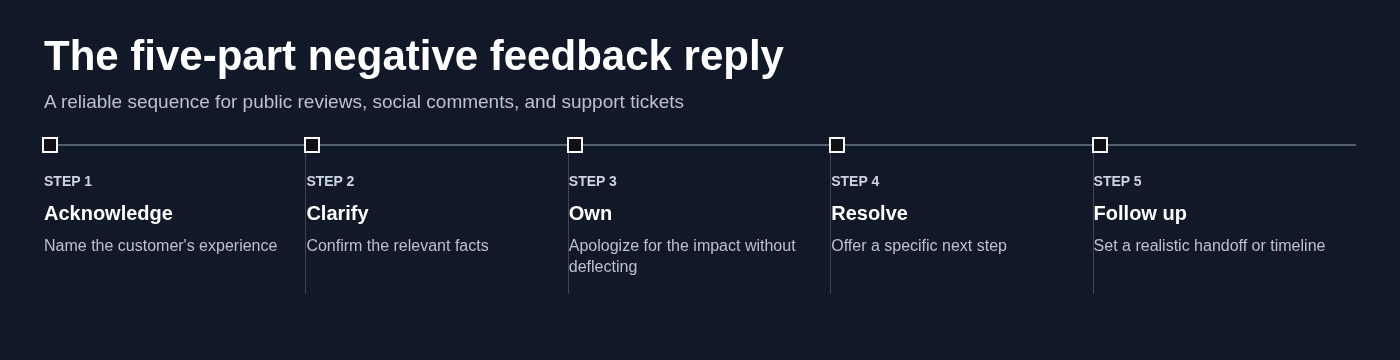
When people ask how to professionally respond to negative feedback, the answer is usually less about finding the perfect apology and more about following a clear sequence. A useful five-part reply keeps the message human while preventing agents from rambling or becoming defensive.
- Acknowledge: Name the experience or impact the customer reported.
- Clarify: State the relevant facts you have verified, or explain what you need to check.
- Own: Apologize for the impact without blaming the customer or making unsupported admissions.
- Resolve: Give one concrete next action, such as reviewing an order, escalating a case, or arranging a replacement.
- Follow up: Set a realistic handoff, owner, or timeline.
In a public review or social comment, keep the reply brief. Acknowledge the issue, avoid account-specific details, and invite the person to a private channel. In a support ticket or email, you can include more context once you have confirmed it is accurate.
Specificity matters. "We are sorry for the inconvenience" is weak when it stands alone. "I am sorry your delivery arrived after the date we confirmed. I have asked our fulfillment team to review the shipment and will update you by tomorrow" gives the customer something tangible.
Before and after: turning a defensive reply into a useful one
Consider this fictional but representative case. A customer posts that an order arrived several days late and says they will not buy again.
Weak reply: "Shipping delays happen and were outside our control. Tracking was sent to your email, so please check it before leaving a review."
This response may contain a fact, but it does not address the customer's experience. It shifts responsibility, sounds accusatory, and gives no indication that anyone will investigate.
Improved reply: "Hi Jordan, I am sorry your order arrived later than expected. We understand how frustrating that is, especially when you planned around the delivery date. We would like to review what happened and see how we can help. Please send us a direct message with your order number, and our support team will take it from there."
The revised version does four things better. It recognizes the impact, accepts responsibility for helping even if the cause is still being checked, avoids debating the customer in public, and offers a clear next step. It protects trust because readers can see a route to resolution rather than an argument.
Negative feedback response template for a general complaint
Use this for email, support tickets, feedback forms, or any complaint where the customer has described a specific problem.
Template:
"Hi [Customer name], thank you for letting us know about [issue]. I am sorry that [specific impact]. We are reviewing [what you can verify or investigate] so we can understand what happened. [Your next action] by [realistic timeframe, if confirmed]. If you can share [minimum needed detail], that will help us move this forward. Thank you for giving us the opportunity to address this."
Completed example:
"Hi Maya, thank you for letting us know that the setup instructions did not match the product you received. I am sorry this delayed your installation. We are reviewing the current instruction version with our product team. I will send you the corrected steps by tomorrow afternoon. If you can reply with the model number from the label, that will help us make sure we send the right guidance."
Personalize the customer's name, the reported issue, the real-world impact, who owns the next step, and what happens next. Avoid excessive apologies and risky statements such as "This was completely our fault" before an investigation is complete. You can sincerely apologize for the inconvenience and the experience without speculating about cause or liability.
Negative review response examples for public platforms
Public responses have two audiences: the reviewer and everyone else reading the thread. Your job is not to win a debate. It is to show that the business listens, takes concerns seriously, and has a sensible process for resolving them.
Whether the review appears on Google, Yelp, a marketplace, or another public platform, keep it proportionate. A brief review needs a brief, useful answer. A detailed complaint may warrant a little more acknowledgement, but do not publish order numbers, account history, payment details, or internal case notes.
1. A service delay or missed expectation
Template:
"Hi [Name], we are sorry that [service or delivery] did not happen when you expected. We understand the impact that delay can have. Please contact us at [contact route] with [safe reference detail], and we will review the situation and let you know the available next steps."
Example:
"Hi Alex, we are sorry your appointment did not begin at the scheduled time. We understand that waiting disrupts your day. Please send us a direct message with the date of your appointment, and we will review the details with the team."
Do not lead with staffing issues, carrier problems, or other explanations. Context can be useful after the issue is reviewed, but it should not read like an excuse.
2. A product or billing problem
Template:
"Hi [Name], we are sorry to hear about the problem with [product, charge, or subscription]. We want to look into this carefully and make it right where possible. For your privacy, please contact [private channel] with your order or account reference, and our team will review the details."
Example:
"Hi Priya, we are sorry that your subscription experience has been frustrating. We would like to check the charge and account status, but we should do that privately to protect your information. Please message our support team with the email associated with your account."
Never try to resolve payment or order specifics in the review itself. Publicly acknowledge; privately verify.
3. A review with inaccurate claims
Customers can be mistaken. That does not make a public correction an invitation to prove them wrong line by line. Correct one material fact calmly, offer to investigate, and stop there unless further clarification genuinely helps other readers.
Template:
"Hi [Name], we are sorry this was your impression. We would like to clarify that [one verified fact]. There may be details we have not yet seen, so please contact us at [private route] with [reference], and we will review the situation directly."
Example:
"Hi Sam, we are sorry the experience did not meet expectations. We can confirm that the service was not canceled, but it appears there may have been confusion about the scheduled date. Please send us a message with your booking reference so we can review the full record with you."
If the review is plainly abusive, repetitive, or written only to provoke, a detailed rebuttal usually makes the situation worse. Follow the platform's moderation options where appropriate, document the issue, and reserve public replies for cases where a calm response adds value.
Best replies for bad comments on Instagram and other social channels
Negative comments move faster on social channels. Long explanations can invite more replies, and a public thread can quickly become a performance rather than a support conversation. Keep your response short, respectful, and easy to act on.
Disappointed comment: "We are sorry this did not meet your expectations, [Name]. We would like to understand what happened. Please send us a DM with a few details so we can help."
Frustrated repeat customer: "We understand why you are frustrated, especially after reaching out before. Please DM us your previous case reference or the email used to contact support, and we will make sure this is reviewed by the right person."
Comment that needs an immediate move to DMs: "We want to help with this, but we do not want you to share account details here. Please send us a DM with your order number, and we will review it privately."
A customer-service response is not always the right response. Hide, restrict, or report threats, personal attacks, doxxing, hate speech, and spam according to your moderation policy and the platform's available tools. Do not attempt a public recovery conversation with someone who is creating a safety issue.
Templates for recurring support scenarios
The best reply depends on what your team knows and what remedy is actually available. A clear operational library is more useful than a folder of generic "sorry for the inconvenience" messages because it gives agents guidance for the decision in front of them.
When the team made a clear mistake
Template:
"Hi [Name], you are right to raise this. We made an error with [specific issue], and I am sorry for the impact on [specific outcome]. We are correcting this by [remedy]. You can expect [next step] by [realistic timing]."
Direct ownership earns more trust than vague language. Avoid "We apologize for any inconvenience" when you know exactly what went wrong and what you are doing about it.
When you need to investigate first
Template:
"Hi [Name], I am sorry you have had this experience. I want to make sure we review the right details before giving you an answer. Please send [minimum details needed], and I will check this with [relevant team] and update you by [realistic timeframe]."
This is not an evasion when the investigation is real. It is better than guessing, promising a remedy too early, or asking for every possible detail before you have reviewed the basics.
When the requested outcome is not possible
Template:
"Hi [Name], I understand why you requested [outcome], and I am sorry we cannot provide that option in this case. What we can offer is [available option]. If you would like to proceed, [clear next step]."
A respectful refusal explains the path that is available without blaming the customer for the limitation. Do not bury the answer under policy language or imply the person should have known better.
When the customer has already contacted support
Template:
"Hi [Name], I am sorry you have had to contact us more than once about this. You should not need to repeat the full story. I have asked [owner or team] to review your existing case, and [next update or escalation route]."
Repeated effort is often the real source of frustration. Asking the customer to start over signals that your internal process matters more than their time.
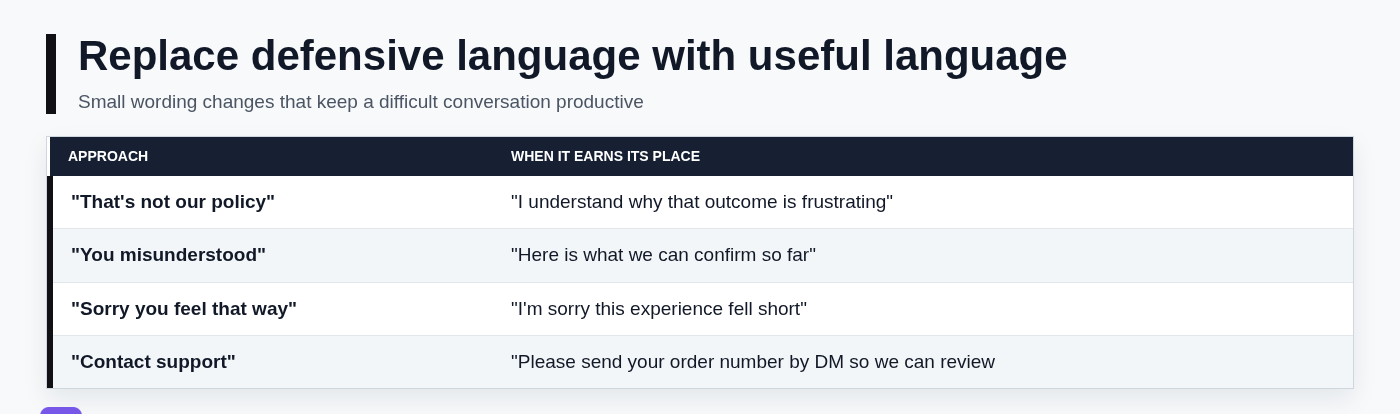
Good negative feedback phrases - and phrases that make things worse
Good negative feedback phrases are specific, accountable, and oriented toward action. They recognize the customer's experience without automatically accepting every conclusion or escalating the language.
| Instead of this | Try this |
|---|---|
| "That's not our policy." | "I understand why that outcome is frustrating. Here is what we can do next." |
| "You misunderstood." | "Here is what we can confirm so far, and we would like to review the remaining details." |
| "Sorry you feel that way." | "I am sorry this experience fell short of what you expected." |
| "Contact support." | "Please send your order number by DM so we can review this today." |
| "There is nothing we can do." | "We cannot offer [requested outcome], but we can offer [available option]." |
Useful phrases include "Thank you for bringing this to our attention," "I understand the impact this had," "We are reviewing the details," "Here is the next step," and "I will update you by [time]." Use them only when they are true and followed by action.
Constructive negative feedback is different from simply negative language. "The handoff did not include the case notes, so the customer had to repeat their issue" is actionable. "You are careless" attacks a person and gives them little to improve. Focus on the situation, observable behavior, impact, and requested change.
How to politely give negative feedback internally
Giving negative feedback to a boss or colleague has a different purpose from responding to a customer complaint. You are trying to improve a working relationship or process, not de-escalate a service issue in public.
A simple structure works well: situation, behavior, impact, request. Name the circumstance, describe what happened without guessing motives, explain the practical effect, and ask for a specific change.
Example for a manager: "In Monday's project review, the priorities changed after the team had already started the previous work. That created rework and made it difficult to plan deadlines. Could we confirm priority changes in writing before the team starts the next stage?"
Give this kind of feedback privately when possible. Stick to observable facts, avoid absolutes such as "always" and "never," and make the desired change clear enough that the other person can act on it.
What negative feedback means - and what it does not mean
Negative feedback in customer service means a customer reports dissatisfaction, friction, or an unmet expectation. Three everyday examples are a late delivery, confusing setup instructions, and an unhelpful support handoff that forces someone to explain the problem again.
People also use several broad labels when discussing feedback: positive feedback recognizes a helpful behavior or outcome; negative feedback identifies a problem or gap; reinforcing feedback encourages a behavior to continue; and balancing feedback combines recognition with a request for improvement. The labels overlap in practice. What matters is whether the feedback is specific and useful.
A positive example might be, "Your setup guide made installation straightforward." A negative example might be, "The setup guide skipped the step needed for my model." The latter is not inherently hostile; it gives the team a clear place to investigate.
A negative feedback loop is a separate systems concept. In biology, engineering, and everyday equipment, it means a process counteracts a change to keep things stable. A thermostat is the familiar example: when a room gets colder than the chosen temperature, the heating system turns on; when the target is reached, it turns off. A positive feedback loop amplifies a change instead, such as microphone feedback becoming louder as sound feeds back into the speaker.
Build a response library your team will actually use
Templates only help if agents can find the right one quickly and know when it applies. Start by reviewing recent complaints and tagging repeat scenarios: delivery delays, billing questions, setup confusion, repeat contacts, account access, and public social comments.
For each scenario, create an approved public reply, private follow-up, and escalation instruction. Include required personalization fields so agents cannot accidentally send a generic message with no reference to the actual problem.
A lightweight response sheet can include:
- Scenario: What happened and when to use this template.
- Public reply: The short response suitable for reviews or comments.
- Private follow-up: The message that gathers details or explains the remedy.
- Owner: The team or person responsible for the next step.
- Escalation rule: When to involve a manager, billing specialist, safety team, or product team.
A practical naming convention makes a real difference: use names such as Review - Delivery Delay - Public, Billing - Investigate - Private, or Social - Repeat Contact - DM. Consistent names make search faster than folders full of similarly titled drafts.
A reusable snippet manager such as SnipFlux can keep approved replies, links, and escalation instructions searchable for the people who need them. It does not replace investigation or judgment. It helps teams save, organize, find, and expand the language they have already approved, so agents can spend more attention on the facts of the case.
Review the library monthly. Retire responses that no longer match policy, update wording based on recurring questions, and look for complaint patterns that point to a product or process issue rather than an agent-writing problem.
SnipFlux
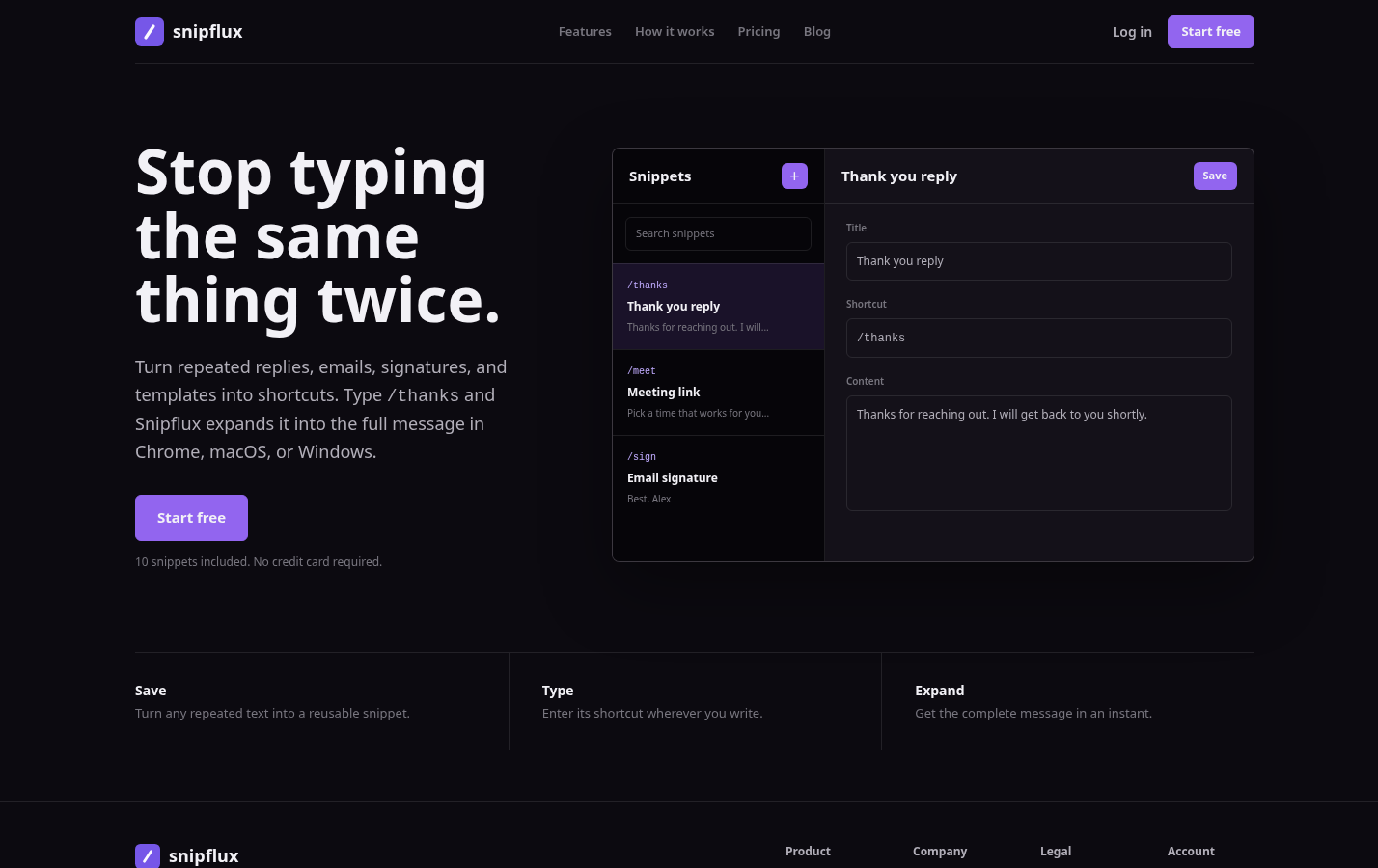
SnipFlux is best for teams and professionals who repeatedly reuse short-form text such as support replies, sales follow-ups, signatures, instructions, links, and templates. You can save a snippet with a clear title and memorable shortcut, organize it with folders and labels, search for it when needed, and expand it in a supported writing field by typing its shortcut, or copy it when that better fits the task.
For a negative feedback workflow, that means keeping a separate, searchable set of approved responses for public reviews, social comments, investigation holds, escalation messages, and private follow-ups. Workspaces and invitations can also help teams maintain a shared source of approved wording rather than passing outdated templates around in documents.
The important limitation is that SnipFlux is a text snippet manager, not a system that investigates cases, tracks customer records, or writes the response for the agent. It is most useful when your team already knows its escalation process and needs a faster, more consistent way to retrieve the right starting language.
Use templates to respond faster without sounding scripted
The best negative feedback response does not sound polished for its own sake. It shows that someone read the issue, understood the impact, and took a specific next step.
Investigate before explaining. Acknowledge the real experience. Give only verified information. Then personalize the template enough that the customer can see it was written for their situation.
For teams managing recurring replies, organizing approved templates in SnipFlux can make that consistency easier to maintain without turning support conversations into scripts.