A delayed hiring process is frustrating for candidates, but the email itself is straightforward: acknowledge the delay, share an honest level of context, confirm their status if appropriate, and give a specific date for the next update. Do not wait until you have a final decision to communicate.
Silence forces candidates to guess whether they are still being considered. A brief, thoughtful update will not remove the inconvenience, but it shows respect for the time they have already invested.
What to say when the hiring process is delayed
Name the delay, give honest context without exposing internal details, confirm the candidate's status only if true, and commit to the next update by [Thursday, Month Day]. Even without a final decision, a clear next touchpoint is more useful than "We will be in touch soon."
Hiring process delay email template
Use this general template for candidates who have already interviewed. Adjust the detail and tone to match how far they are in the process.
Subject line options:
- Update on the [Role Title] hiring process
- An update on your interview for [Role Title]
- Timeline update: [Role Title] at [Company]
Email template:
Hi [Candidate Name],
Thank you again for taking the time to speak with us about the [Role Title] position. I wanted to share an update on our timeline.
Our hiring process is taking longer than expected due to [brief, honest reason]. We are still [reviewing candidates/completing interviews/finalizing internal approvals], and we expect to have a clearer update by [specific date].
[If true: Your application remains under consideration.] I appreciate your patience and the time you have invested in the process. If you have questions in the meantime, please feel free to contact me at [recruiter email or contact method].
Best,
[Recruiter Name]
[Title]
[Company]
Only say that a candidate remains under consideration when that is actually true. This is a status update, not a reason to offer false reassurance or imply an outcome that has not been decided.
Why timely delay updates matter to candidates
Timely updates protect trust. A brief note may suit a recent interview, but candidates who have completed several rounds deserve a more personal update. A delay email should set expectations while a real decision or process change is still underway—not quietly extend the wait.
The five details every delay email needs
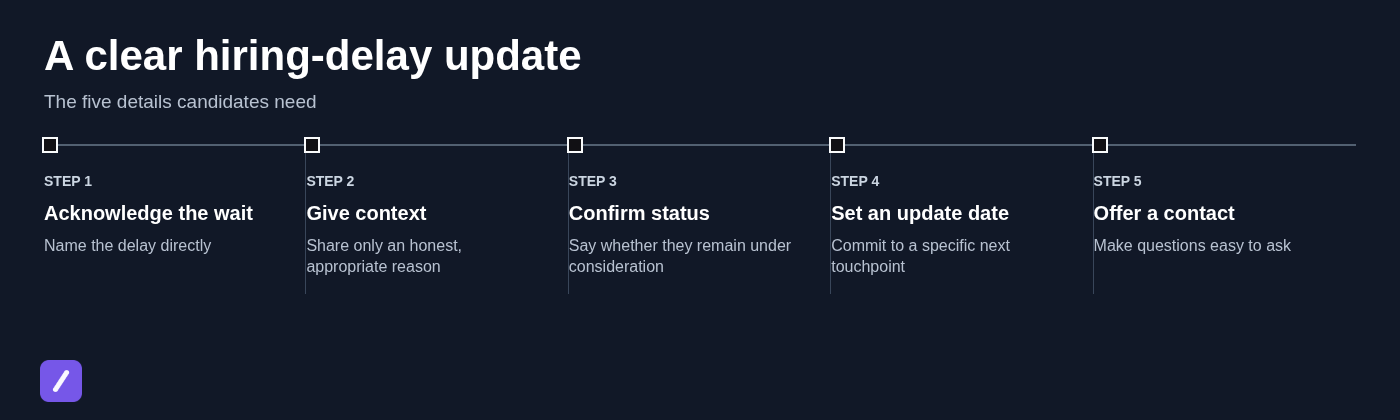
A credible hiring delay email should answer five basic questions before the candidate has to ask them.
- Acknowledgment: Name the wait directly and thank the candidate for their patience.
- Concise reason: Give honest context, such as pending approvals, remaining interviews, or a scheduling delay.
- Candidate status: Clarify whether they remain under consideration, but only if you can say that truthfully.
- Specific next-update date: Commit to a real date for the next contact.
- Clear point of contact: Tell the candidate who can answer questions.
The next-update date is the most commonly missed detail. "As soon as possible" and "soon" may sound polite, but they are not useful. Candidates need to know whether they should expect a response tomorrow, next week, or after an internal decision meeting.
Templates for common hiring delays
Different delays call for different language. Replace every placeholder, check that the reason is accurate, and do not use an explanation you cannot substantiate.
Delay caused by internal approvals or shifting priorities
This template works when a budget review, headcount approval, or change in team priorities has slowed the role. Be candid about uncertainty rather than pretending the process is moving normally.
Subject: Update on the [Role Title] position
Hi [Candidate Name],
I wanted to provide an update on the [Role Title] hiring process. We are currently completing an internal review related to [headcount approval/team priorities/budget planning], which has delayed our timeline.
We do not yet have a final decision on the role's timing. However, I will contact you by [specific date] with an update, even if the review is still in progress. [If true: Your application remains under consideration.]
Thank you for your time and patience. Please feel free to reach out if you have questions.
Best,
[Recruiter Name]
Delay while the interview team completes evaluations
For post-interview delays, explain that the team is still finishing evaluations or coordinating feedback. Do not call someone a finalist unless that has been confirmed internally.
Subject: Next steps for the [Role Title] interview process
Hi [Candidate Name],
Thank you again for speaking with our team about the [Role Title] role. We are still completing interviews and consolidating feedback, so our decision process is taking a little longer than planned.
[If true: You remain under consideration for the position.] I will share our next update by [specific date].
We appreciate the time you spent with us and your continued interest in [Company].
Best,
[Recruiter Name]
Delay because of a holiday, leave, or unexpected absence
A short message is usually enough when a holiday or temporary absence moves the timeline by only a few days. Avoid oversharing another employee's personal circumstances. If the delay becomes longer or affects the role itself, send a fuller update instead.
Subject: Timing update for the [Role Title] process
Hi [Candidate Name],
A scheduling change has pushed our [Role Title] interview timeline back slightly. We now expect to provide an update by [specific date].
Thank you for your patience, and please let me know if you have any questions in the meantime.
Best,
[Recruiter Name]
Delay after a final interview
After a final interview, candidates deserve a higher-touch note. They have usually committed significant preparation time and may have been told to expect a quick decision. Use a personal sign-off and make a firm commitment to the next update, even if you cannot promise a final decision date.
Subject: Update following your final interview for [Role Title]
Hi [Candidate Name],
Thank you again for the time and preparation you brought to your final interview for the [Role Title] role. I know this process has required a meaningful investment, and I wanted to let you know that our final decision is taking longer than expected.
We are [brief reason, such as completing final stakeholder discussions], and I will personally update you by [specific date], whether or not we have reached a final decision at that point.
Thank you for your patience and continued interest in [Company]. Please do not hesitate to contact me directly if you have questions.
Warmly,
[Recruiter Name]
How to write an email when your response is delayed
When your response is late, apologize, share the current status, and commit to the next action.
Vague:
Hi [Candidate Name],
Thank you for your patience. Things have been busy on our end, and we hope to have an update for you soon.
Clearer:
Hi [Candidate Name],
I apologize that we have not updated you by the timeline we discussed. Our interview panel needs additional time to complete feedback for the [Role Title] role. I will email you by [Friday, Month Day] with our next update, even if a final decision is not yet ready.
The clearer version acknowledges the missed expectation, gives context, and defines what happens next.
How often to update candidates during a prolonged delay
Send the first notice as soon as the original timeline slips. After that, update candidates on every date you promised, including when there is no meaningful change.
For a delay lasting more than a week or two, a weekly update is often reasonable if the candidate remains active in the process. The message can be brief: confirm that the process is still delayed, state the current status, and give the next update date.
There is a limit. If the role is paused indefinitely, likely to be cancelled, or cannot proceed within a sensible period, close the loop. Repeatedly extending the wait damages trust more than an honest message that says the company cannot move forward at this time. If the role is ultimately closed, a clear candidate rejection email is better than leaving applicants without an answer.
Mistakes that make a delay email feel dismissive
The most damaging mistake is vagueness. Candidates do not need every detail of an internal approval process, but they do need a realistic timeline and a clear understanding of whether they should expect another message.
- Using vague timing: Replace "soon" with a date.
- Overexplaining internal issues: Share enough context to be credible, not confidential budget discussions or personnel details.
- Sending a generic bulk message after late-stage interviews: The more time a candidate has invested, the more personal the update should be.
- Implying certainty that does not exist: Do not promise an offer, a decision date, or continued consideration unless you can stand behind it.
- Missing your own follow-up date: If another delay occurs, contact the candidate before the promised date passes.
Personalization does not require writing every email from scratch. It means matching the message to the candidate's stage, prior conversations, and level of investment. A first-round candidate may receive a concise update; a finalist should receive a note that recognizes their specific effort.
Make candidate updates easier to send consistently
Recruiting teams should maintain approved templates for common delays, with clear fields for the candidate's name, role, status, reason, and next-update date. That makes it easier to respond promptly while preserving a consistent and respectful tone. A reusable interview invitation email template can also help keep earlier scheduling messages consistent before delays occur.
SnipFlux can help recruiters save vetted candidate-update templates as reusable snippets and insert them with shortcuts across supported writing fields. Keep separate versions for interview scheduling, approval delays, final-stage updates, and paused roles, then personalize the details before sending.
The core rule is simple: honesty plus a concrete next update protects trust far better than silence. Candidates can handle a delay. What they should not have to handle is being left without an answer.