A candidate rejection email should be timely, clear, and respectful: thank the person, state that they will not move forward, and avoid leaving them to guess where they stand. The right wording depends on how far they reached in the process. A bulk application update can be brief; someone who completed interviews deserves more acknowledgement.
Done well, a rejection email is not just an administrative task. It is part of the candidate experience and, by extension, your employer brand. The goal is not to defend every hiring decision. It is to communicate a final outcome with professionalism.
What a candidate rejection email should include
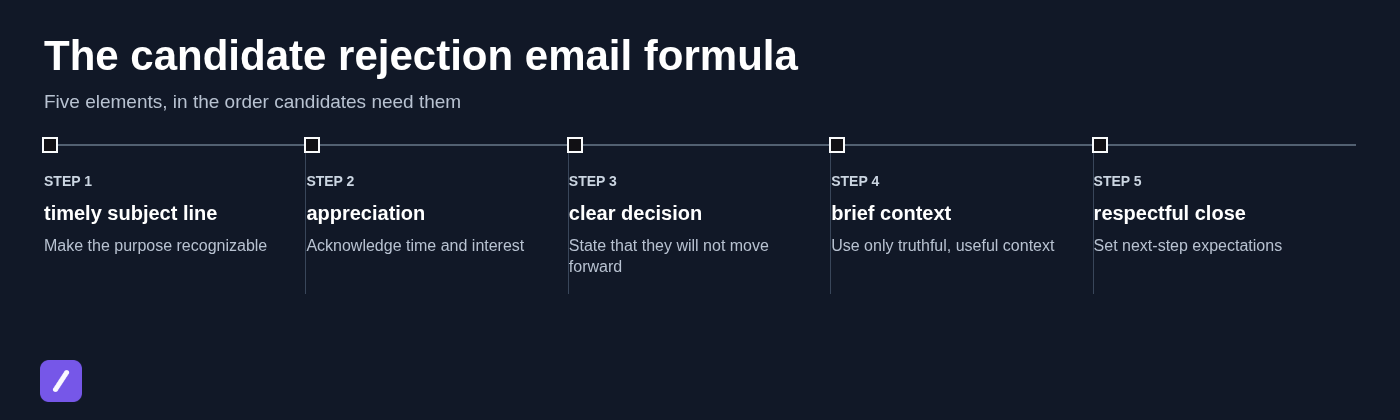
Every professional candidate rejection email needs five things: a recognizable subject line, appreciation for the candidate's time, an unambiguous decision, any useful and truthful context, and a respectful close.
Personalization should rise with the candidate's investment. For an applicant screened out before an interview, their name, the role title, and a direct status update are usually enough. For an interviewee or finalist, acknowledge the conversation, presentation, work sample, or time spent meeting the team.
Keep the message focused on the candidate's status. A rejection email is rarely the right place to explain every internal discussion, compare candidates, or offer broad claims about why another person was selected. Clear language is kinder than vague language such as "we are still reviewing our needs" when the decision is already final.
Choose the right template for the stage of the hiring process
The best candidate rejection email template is the one that matches the stage of the process. Sending the same generic note to every applicant may be efficient, but it is a poor fit for people who have spent hours interviewing with your team. Keeping a clear interview invitation email template alongside your rejection templates can also help maintain consistent communication throughout the hiring process.
- Applicants not selected for an interview: A concise, professional batch email is generally appropriate.
- Interviewed candidates: Thank them for the conversation and make the decision clear. Add a small personal detail where practical.
- Finalists: A personal email or call is often the better choice, particularly if they completed several rounds or an assignment.
- Future talent-pool candidates: Keep the door open only when there is a real reason you would consider them for another role.
This approach prevents a common mistake: treating every rejection as a mass communication. Efficiency matters, but candidates notice when the message ignores the time they gave your organization.
1. Simple candidate rejection email template for applicants not selected for interview
Use this simple candidate rejection email template for high-volume applications when the person did not progress to an interview. It is brief, direct, and does not imply that the application remains under review.
Subject: Update on your application for [Role Title]
Hi [Candidate Name],
Thank you for your interest in [Company Name] and for applying for the [Role Title] position.
After reviewing applications, we have decided not to move forward with your application at this time.
We appreciate the time you took to apply and wish you the best in your job search.
Best,
[Recruiter Name]
[Company Name]
For early-stage hiring, do not overwork this message. A short rejection email to a candidate is better than a delayed or ambiguous one. If you are sending a batch, verify that the candidate name, role title, and sender information merge correctly before scheduling it.
2. Candidate rejection email template after an interview
A candidate rejection email after an interview should be warmer and more specific than an application update. The candidate has made a larger investment, so acknowledge the interview and state the decision without softening it into uncertainty.
Subject: Update following your interview for [Role Title]
Hi [Candidate Name],
Thank you for taking the time to speak with our team about the [Role Title] position. We appreciated learning more about your experience and your interest in [Company Name].
After careful consideration, we have decided to move forward with another candidate for this role.
[Optional: We selected a candidate whose experience more closely matched the immediate needs of the position.]
Thank you again for your time and interest. We wish you every success in your search.
Best,
[Recruiter Name]
[Title]
[Company Name]
Only include the optional explanation if it is accurate and useful. Avoid saying you will provide detailed feedback unless your team has a consistent process and the recruiter is able to follow through. Likewise, do not promise to consider someone for future roles unless that is a genuine possibility.

3. Short rejection email after interview template
When speed matters, a short rejection email after an interview can still be considerate. Keep the essentials: appreciation, a clear decision, and a respectful sign-off.
Subject: [Role Title] interview update
Hi [Candidate Name],
Thank you for speaking with us about the [Role Title] role. We have decided to move forward with another candidate, so we will not be progressing your application.
We appreciate your time and wish you the best.
Best,
[Recruiter Name]
This version works when you have had a single, relatively brief interview or need to close a process promptly. For a candidate who has met several stakeholders, completed a presentation, or reached the final stage, add a more personal acknowledgement instead of relying on this short form.
4. Formal rejection email template for regulated or structured hiring
A formal rejection email is appropriate when hiring follows a documented process, such as in public-sector, academic, or highly regulated organizations. The language should be neutral, factual, and aligned with internal HR, legal, and equal-opportunity requirements.
Subject: Notification regarding [Role Title] recruitment process
Dear [Candidate Name],
Thank you for your application for the position of [Role Title] with [Organization Name]. We appreciate the time and interest you devoted to the recruitment process.
Following completion of the selection process, we regret to inform you that you have not been selected to proceed further / have not been selected for appointment to this position.
We thank you for your interest in [Organization Name] and wish you success in your future endeavors.
Sincerely,
[Recruiter or Hiring Office Name]
[Organization Name]
Do not use this template as a substitute for policy review. Your organization may have required wording, appeal information, retention rules, or communications procedures. Avoid disclosing comparative assessments, internal deliberations, or information about other candidates.
5. Rejection template that keeps the door open for a future role
Use future-interest language only for candidates you would genuinely consider again. Empty boilerplate such as "please apply again" can sound polite, but it does little for a candidate if your team has no real intention of reconnecting.
Subject: Update on your application for [Role Title]
Hi [Candidate Name],
Thank you for the time you spent interviewing for the [Role Title] position. We enjoyed learning about your experience, particularly your work with [specific relevant area].
We have decided to move forward with another candidate for this opening. However, we were impressed by your background and would welcome the opportunity to consider you for future roles that better match your experience.
[Optional: If you would like, you can sign up for our job alerts at [relevant link] or reply to confirm that we may retain your details for future opportunities.]
Thank you again, and we wish you the best.
Best,
[Recruiter Name]
[Company Name]
The specific action is optional. Include it only if your hiring process supports it and you have an appropriate way to manage candidate details. A sincere note about a particular strength is more credible than a broad invitation sent to everyone.
How to personalize a rejection without overexplaining
Personalization does not require a long explanation. Start with the candidate's name and the exact role. For interviewees, add one truthful line that recognizes their participation, then keep the decision and next steps straightforward.
A practical approach is to scale detail by stage:
- All candidates: Use their name, the correct role title, and a clear outcome.
- Interviewees: Thank them for a specific part of the process, such as discussing their portfolio, meeting the hiring manager, or completing an interview panel.
- Feedback: Share it only when it is specific, fair, approved, and something the recipient can reasonably use.
Safe specifics include: "We appreciated hearing about your customer onboarding work" or "Thank you for the time you spent walking the team through your portfolio." These statements recognize effort without making claims about the candidate's suitability for roles you are not hiring for.
Be cautious with detailed comparative feedback and subjective criticism. Statements such as "you were not confident enough" or "the other candidate was much stronger" can be unhelpful, invite debate, and create unnecessary risk. Compassion is not excessive explanation; often, it is a timely answer delivered plainly.
Common candidate rejection email mistakes to avoid
The most damaging mistake is waiting too long. Candidates may pause their search, decline other conversations, or spend time following up because they assume the process remains active. Send the rejection as soon as the decision is final and approved for communication.
- Using ambiguous language: "We are pursuing other options" can be unclear. Say whether the candidate will not move forward.
- Sending an interviewee an applicant-level form email: Match the message to the effort they invested.
- Making mail-merge errors: A wrong name, role, pronoun, or company name undermines an otherwise respectful note.
- Sounding overly cheerful: Avoid enthusiastic phrases that clash with disappointing news.
- Making false promises: Do not offer detailed feedback, future contact, or talent-pool consideration unless you can deliver it.
- Overexplaining: A long, defensive email can create more confusion than a concise, direct one.
Before sending a batch, check recipient fields, role titles, reply-to settings, and the sender identity. That final review is especially important when multiple openings are active at once.
Build a reusable rejection-email snippet library
A reusable library helps recruiters send consistent, approved messages without rewriting the same email from scratch. Organize templates by hiring stage, then make placeholders unmistakable: [Candidate Name], [Role Title], [Company Name], and [Recruiter Name].
It also helps to keep optional modules separate from the base template. For example, save a short interview-specific thank-you line, a manager-approved feedback paragraph, a talent-pool permission request, and internal signature blocks as individual snippets. Recruiters can then choose only the text that applies rather than deleting unsuitable language from a long master email.
A lightweight workflow is enough for many teams: HR or legal approves the base copy, the recruiter adds appropriate personalization, and a final recipient check happens before sending. This reduces both inconsistency and the temptation to copy an old message with outdated wording.
SnipFlux
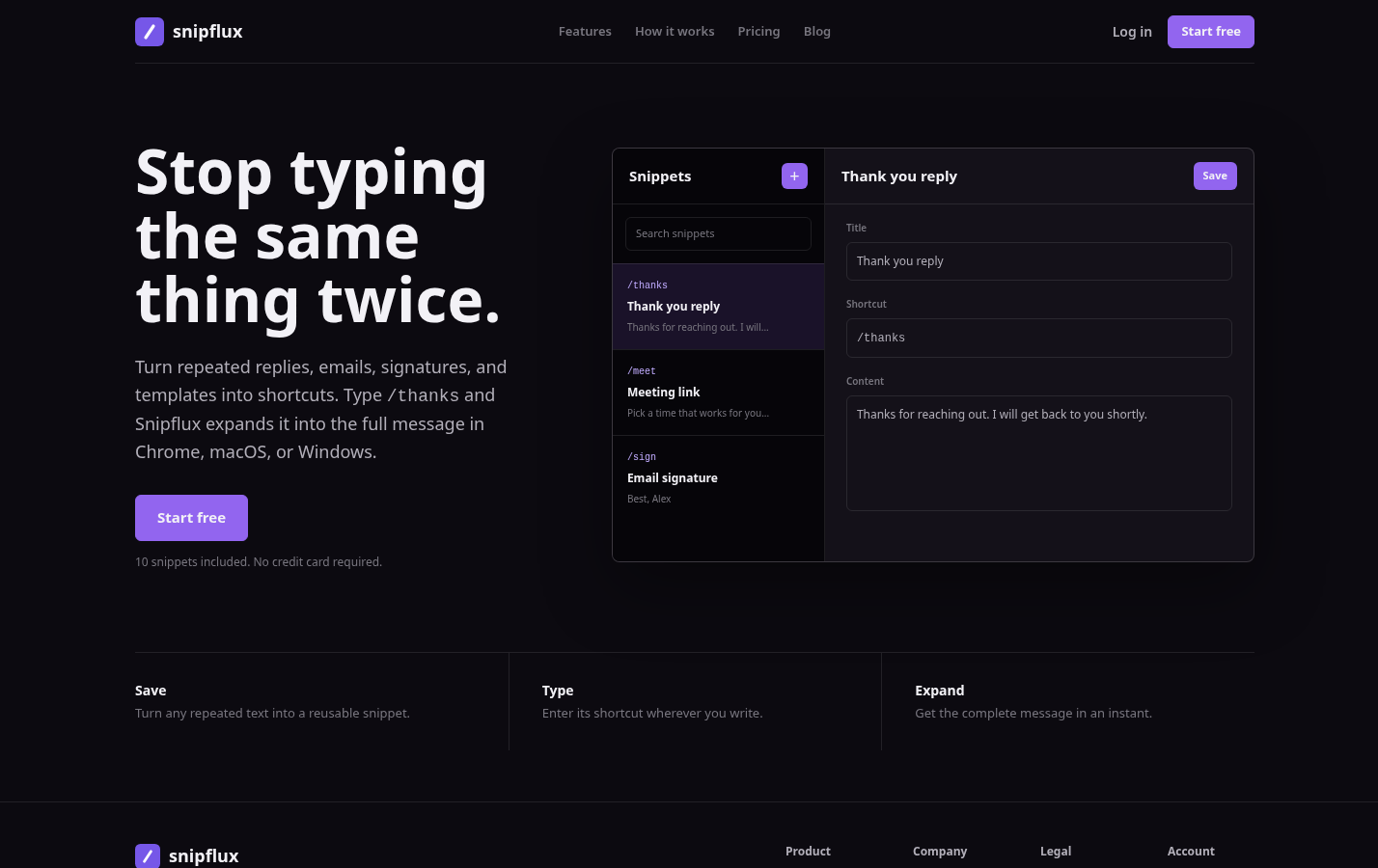
SnipFlux is a cross-platform text expander and snippet manager for teams that repeatedly use approved email language. A recruiter can assign a shortcut to a rejection template, expand it in supported writing fields across Chrome, macOS, and Windows, and then fill in the candidate-specific details.
Its strongest fit is for teams that want an organized library of reusable text, including folders, labels, and shared workspaces for approved templates. It does not replace an applicant tracking system or make the hiring decision for you; recruiters still need to select the correct template, personalize it appropriately, and verify the recipient before sending.
Choose it when repetitive copy-paste is slowing down your hiring communications or creating inconsistency across recruiters. A shortcut such as /reject-interview can bring up the approved post-interview template, while a separate shortcut can serve the high-volume applicant version.
Send a clear, timely rejection that respects the candidate
The standard is simple: match the email to the stage of the hiring process, state the decision clearly, personalize in proportion to the candidate's effort, and send it promptly. A concise message that closes the loop is more respectful than a polished note that arrives weeks late.
Teams that send these messages frequently can save approved versions as reusable SnipFlux snippets, making it easier to stay consistent while leaving room for the human details that matter.