A good discovery call confirmation email does not need to sell harder. It needs to make the meeting easy to attend: confirm the time and format, explain the purpose, request only useful preparation, and give the prospect a painless way to reschedule.
That clarity reduces no-shows and helps both people arrive ready for a productive conversation. The best confirmation emails are short enough to read on a phone, yet specific enough that no one has to search for a calendar invite or wonder what the call is for.
What to include in a discovery call confirmation email
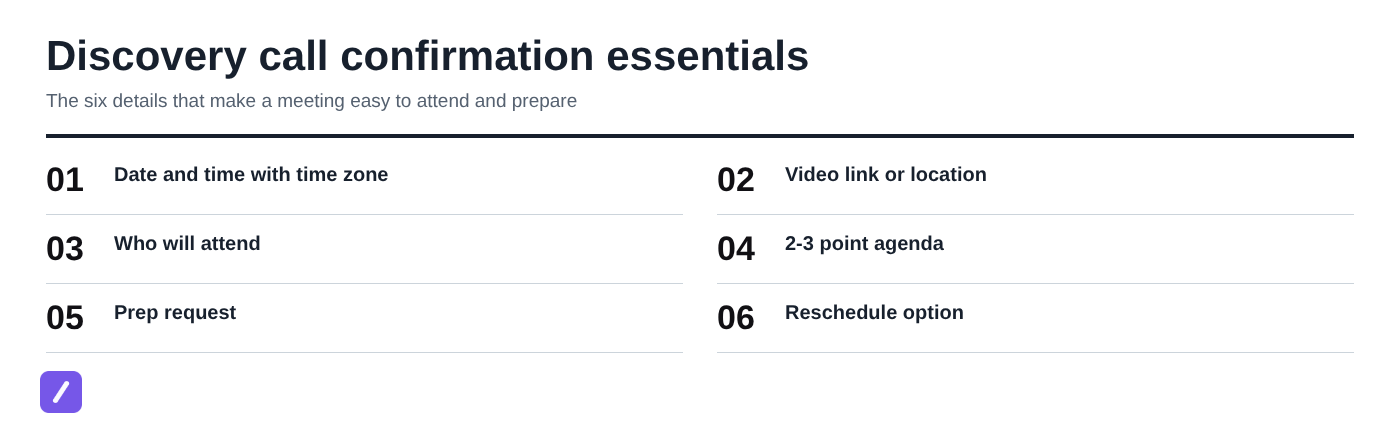
Every discovery call confirmation should cover six practical details: the date and time with a time zone, the meeting format or link, attendees, a short agenda, any preparation request, and rescheduling instructions. If one of those details is missing, the recipient has one more reason to delay, forget, or skip the call.
Start with the logistical essentials. State the full date, time, and time zone rather than assuming the calendar invite answers every question. Include the video link or physical location in the email body, even if it is also in the invitation.
Then set expectations in two or three bullets. A discovery call is for understanding fit, priorities, and context. It is not the place for a long product pitch, a detailed proposal, or a demanding intake process.
Discovery call confirmation email template
Use this template for sales, agency, consulting, or SaaS discovery calls. Customize the bracketed fields, but resist the temptation to add every product benefit or company credential. The recipient has already booked time; your immediate job is to make that time useful.
Subject line options
The best subject line makes the meeting recognizable in a busy inbox. Lead with confirmation and include the date, company, or call topic when possible.
- Confirmed: [Company] discovery call on [Date]
- You're booked: [Call topic] on [Date]
- Discovery call confirmed for [Day, Date]
- Your [Company] call details: [Date] at [Time zone]
- Next step: [Call topic] discovery conversation
Copy-and-paste confirmation email
Subject: Confirmed: [Company] discovery call on [Date]
Hi [First name],
Thanks for booking time to discuss [goal or topic]. We're confirmed for [Day, Date] at [Time] [Time zone].
Join here: [Meeting link]
Who will attend: [Your name, title] and [other attendee, if applicable]
We'll cover:
- Your current approach to [relevant area]
- The outcome you want to achieve and any constraints
- Whether [your company/product/service] is a sensible next step
If helpful, feel free to reply with [one relevant question, example, or link] before the call. No formal preparation is required.
If you need a different time, reply to this email or use [rescheduling link].
Looking forward to speaking,
[Your name]
[Title]
[Company]
[Contact details]
How to write an agenda that earns attendance
A useful discovery-call agenda is specific but lightweight. It should tell the prospect why the conversation matters without turning the confirmation email into a questionnaire.
Keep it to two or three bullets: the current context, the goal or challenge, and a discussion of appropriate next steps. That structure signals preparation and respect for their time while leaving room for the conversation to develop naturally.
State the purpose in one sentence
Connect the call to the reason the prospect booked it. Generic lines such as "learn more about your business" sound automated and give the recipient little reason to prioritize the meeting.
Instead, write something like: "We'll look at how your support team currently handles recurring customer questions and whether a shared response library could reduce reply time." That sentence gives the call a clear center without pretending you already know the answer.
If the meeting came through a referral, mention the referral context. If it followed a specific inquiry, use the prospect's language where it still makes sense. Small details make a confirmation feel intentional rather than mass-sent.
Set expectations without overcommitting
Say what you will discuss, not what you will definitely deliver. Discovery is where you determine whether a solution, proposal, pricing discussion, or product walkthrough makes sense.
For example: "If it looks like there is a strong fit, we can agree on the right next step, which may include a tailored walkthrough." That is more credible than promising a full solution before you understand the workflow, budget, timeline, or stakeholders.
There are exceptions. If the prospect explicitly booked a pricing call or technical demo, say so and prepare accordingly. But do not label every first conversation as a demo simply because your team hopes it will lead there. If a discovery call leads to a proposal, a focused proposal follow-up email template can help maintain that clarity in the next step.
What should a prospect prepare for a discovery call?
Usually, very little. Ask only for information that will materially improve the conversation, such as the current process, desired outcome, timeline, or a relevant example. Long pre-work lowers attendance, especially for an initial call.
Ask for low-effort preparation
One to three optional prompts are usually enough:
- Agency: "If you have one or two examples of sites or campaigns you like, feel free to send them over."
- B2B software: "It would help to know which team will use the workflow and what tool you use today."
- Professional services: "If there is a deadline or decision date driving this conversation, please let me know."
A short form is worthwhile only when it changes qualification, routing, technical preparation, or who should attend. Do not repeat questions the prospect already answered. If several people will attend, ask briefly for names, roles, and priorities; for internal coordination after the call, a team handoff message template can capture those details without making the prospect repeat them.
Choose the right send time and reminder sequence
Send the confirmation immediately after booking. The recipient should receive the details while the meeting is still fresh, not hours later after they have moved on to something else.
For most discovery calls, one reminder about 24 hours before the meeting is enough. A final short reminder shortly before the call can be appropriate for high-volume sales teams, busy executives, or meetings booked several weeks in advance, but avoid turning reminders into noise.
Always make the time zone explicit in the email, especially for remote teams and international prospects. A calendar invitation is helpful, but it is not a substitute for clear written logistics. Include the join link in the reminder as well so the recipient does not need to hunt through an older message.
Personalize the template without slowing down your team
You do not need to write every confirmation from scratch to make it feel personal. Tailor the prospect's stated goal, the call context, expected attendees, and the agenda point most relevant to their situation.
The rest can remain standardized. Consistency protects against common mistakes such as a missing meeting link, incorrect time zone, or an outdated rescheduling instruction.
Create reusable snippets for confirmation and reminder emails
Create a base template with fields such as [First name], [Date], [Time zone], [Meeting link], and [Goal]. Add a short opening line yourself, then replace the fields before sending. This approach is faster than repeated copy-paste and makes approved wording easier for a team to reuse.
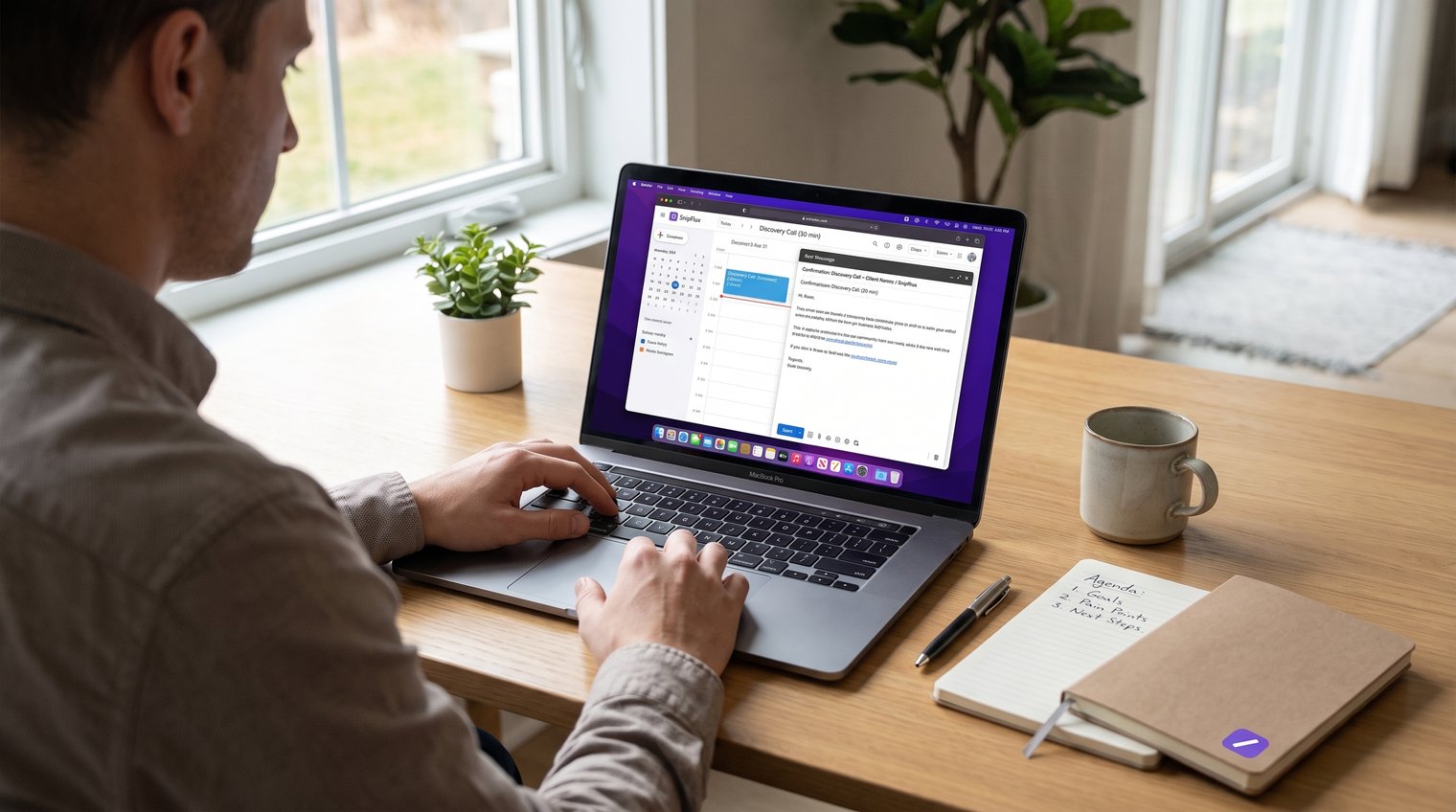
For sales, support, or other shared-template teams, this keeps approved wording consistent while leaving the call-specific fields open for personalization. SnipFlux is a cross-platform text expander that can store a confirmation template as a reusable snippet and insert it with a shortcut across Chrome, macOS, and Windows. A shortcut such as /discovery-confirm can give your team the approved structure instantly, while still leaving room to personalize the call purpose and agenda.
Examples for common discovery-call scenarios
Match the agenda and optional preparation request to the conversation:
- Inbound lead: Cover the problem, current approach, and decision timeline. Ask: "If there is a specific use case you want to prioritize, reply with a sentence or two before our call."
- Agency or consulting: Focus on goals, rough scope, decision-makers, and timing. Useful context, such as an existing website or campaign, can help; avoid requesting a full creative brief before establishing fit.
- Product-led or technical: Discuss the workflow, team size, systems involved, and success criteria. If relevant, ask which tools need to connect and which workflow the team hopes to improve.
Common confirmation email mistakes to avoid
The most damaging mistakes are simple: no time zone, no join link, a vague agenda, excessive preparation requirements, or an unclear way to reschedule. Each creates avoidable uncertainty at the moment you want attendance to feel effortless.
- Relying only on the calendar invite: Put the date, time, and meeting link in the email too.
- Writing a vague agenda: "Let's connect" does not explain why the call deserves attention.
- Requesting too much homework: Ask only for details that will change the conversation.
- Hiding rescheduling instructions: A simple reply or rescheduling link is enough.
- Turning the email into a sales brochure: Confirmation emails are operational messages, not a second pitch deck.
- Making the recipient book twice: Do not send them through another scheduling process after they have already selected a time.
Clarity beats enthusiasm here. A short, complete email is more useful than a polished but crowded message full of claims, links, and competing calls to action.
Send a confirmation that makes the call easy to join
A strong discovery call confirmation is immediate, specific, and easy to act on. Confirm the logistics, give a focused agenda, keep preparation minimal, and provide one clear path to reschedule.
Once your team has approved a version that works, save it as a SnipFlux snippet so people can insert the structure consistently and personalize the details that matter. That keeps confirmations fast without making them feel generic.