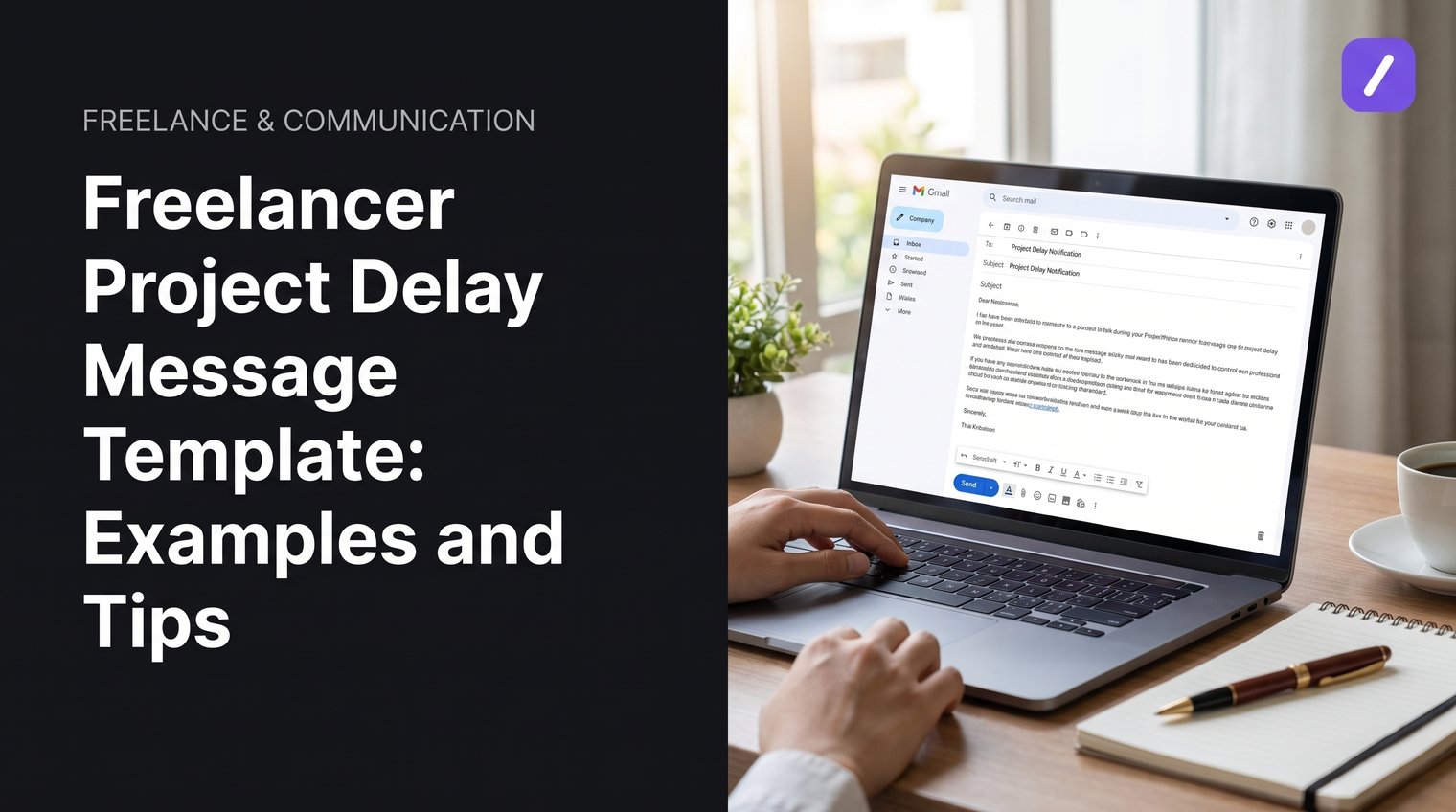
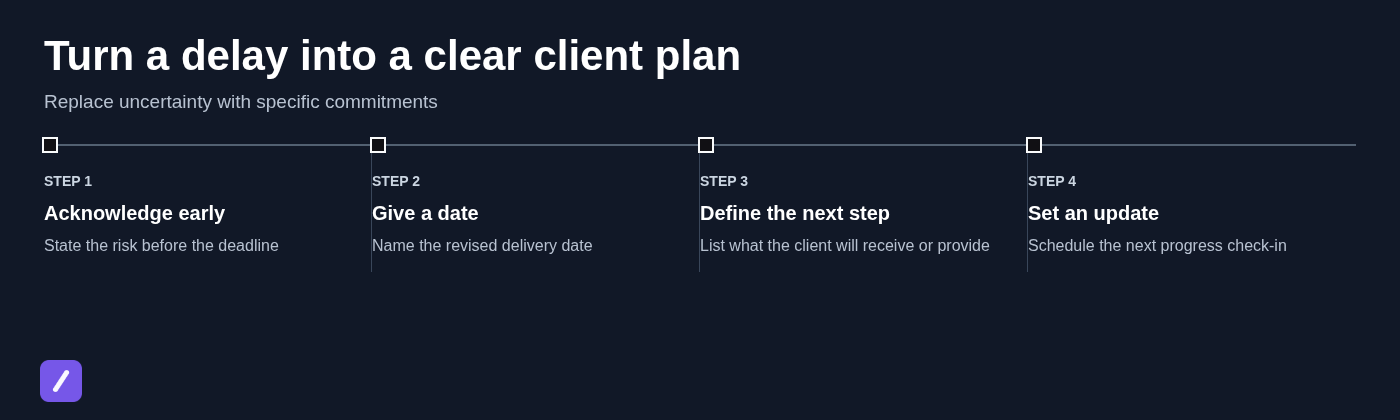
A project delay does not automatically damage a client relationship. Silence, vague apologies, and promises you cannot keep do. Send an update as soon as the deadline is at risk, explain the impact briefly, give a realistic revised date, and tell the client what happens next.
The best freelancer project delay message is proactive and specific. Use this general template, then adapt it to the actual reason and severity of the delay.
A client-ready freelancer project delay message template
Subject: Update on [Project Name] delivery
Hi [Client Name],
I am writing to let you know that the [project/deliverable] originally scheduled for [original delivery date] needs additional time to complete to the agreed standard. I now expect to deliver [specific deliverable] by [revised delivery date].
[One concise sentence of relevant context, such as: "The remaining work involves integrating the final feedback and completing quality checks."]
My next step is [specific action], and I will send you a progress update by [next checkpoint date]. Please let me know if the revised timing creates a constraint on your side so we can discuss the best path forward.
Thank you,
[Your Name]
This works because it answers the questions a client actually has: What is delayed? When will it arrive? What are you doing about it? A long apology without those details creates more uncertainty, not more trust. You can save this framework as a reusable snippet, then customize the client, deliverable, dates, and context before sending.
What to include in a project delay message
A strong delay message needs five things: a clear opening, early notice, concise context, a realistic new date, and a concrete next step. If one is missing, your client may still be left guessing.
- Clear subject line or opening: State that the message concerns the project timeline. Do not bury the news under a casual check-in.
- Early notice: Tell the client when you identify the risk, not when the deadline has already passed. Even a preliminary update is better than waiting for perfect certainty.
- Concise context: Explain the delivery impact without turning the message into a personal diary or a defense brief.
- Realistic revised date: Give a date for a named deliverable, not "soon," "ASAP," or "early next week."
- Recovery plan or checkpoint: Say what you will do next and when the client will hear from you again.
An explanation is not the same as an excuse. "The final integration is taking longer than estimated" provides useful context. "My subcontractor let me down, and everything has been chaotic" shifts blame and makes the client wonder whether the problem is under control.
Build a buffer into the revised date. If you think the work will take two more days, do not promise delivery tomorrow evening. Account for review time, formatting, testing, client questions, and the ordinary surprises that caused the schedule issue in the first place.
Choose the right template for the situation
One generic apology is rarely enough. The right message depends on whether you need a minor extension, are waiting on an input, have uncovered a scope change, or have a serious issue that affects the entire schedule.
When you need a short extension before the deadline
Use this when the delay is small and you can confidently commit to the new date.
Hi [Client Name],
I wanted to flag a small timing adjustment for [project/deliverable]. Rather than delivering on [original date], I will send the completed [specific deliverable] by [revised date and time].
I am using the additional time to [brief reason, such as complete final revisions and quality checks]. If this timing conflicts with a launch or internal deadline, please let me know today and I will confirm the best option.
Best,
[Your Name]
Keep this short. A minor extension should not sound like a major crisis, but the new delivery commitment must still be firm.
When a dependency or client feedback is holding up the work
If you are blocked by missing assets, approval, access, or feedback, state the dependency neutrally. The goal is to clarify the schedule, not make the client feel accused.
Hi [Client Name],
To complete [deliverable], I still need [specific feedback, asset, approval, or access]. Once I receive it, I will need [timeframe] to complete the remaining work and deliver the final version.
If I receive [needed input] by [date], the revised delivery date will be [new date]. If it arrives later, I will update the schedule accordingly. Please let me know if there is another person I should coordinate with to keep this moving.
Thank you,
[Your Name]
This phrasing identifies cause and effect: the missing input changes the schedule. It avoids loaded language such as "you still have not sent" or "your delay has put me behind."
When an unexpected issue requires a larger delay
For a material delay, communicate early but do not invent a new date just to sound reassuring. Offer only the context needed, explain your recovery plan, and schedule the next update.
Hi [Client Name],
I need to update you on the timeline for [project]. An unexpected issue affecting [brief work area] means I will not be able to meet the current delivery date of [original date] without compromising the quality of the work.
I am currently [recovery action, such as resolving the issue, reassessing the remaining tasks, or arranging an alternative approach]. I will confirm a revised delivery date by [checkpoint date], and I will send you a progress update then even if the final timeline is still being finalized.
I understand this affects your planning, and I am treating the remaining work as a priority.
Regards,
[Your Name]
Minimum necessary context is enough. You do not need to disclose private medical, family, or financial details to communicate professionally.
When the deadline has already passed
If the deadline has passed, send the message immediately. Waiting until the work is finished turns a missed deadline into a communication failure as well.
Hi [Client Name],
I missed the delivery deadline for [project] on [date], and I apologize for not updating you sooner. The current status is [specific status, such as "the draft is complete and I am finishing the final edits"].
I will deliver [specific deliverable] by [credible date and time]. I will also send you a progress update by [earlier checkpoint] so you are not left waiting without visibility.
Thank you for your patience,
[Your Name]
Accountability is more convincing than a dramatic explanation. Name what happened, state where the work stands, and give a commitment you can support.
How to write the message without damaging client trust
Trust is protected by predictability. Before writing, assess the remaining work honestly, estimate the time with a buffer, choose the closest template, and replace every placeholder with project-specific information.
Send through the channel the client normally uses. Email is usually best when the date changes, scope changes, or the client needs a documented timeline. A quick chat message can be appropriate for an urgent heads-up, but follow it with a written confirmation when the schedule has materially changed.
Replace vague language with commitments the client can track. Instead of writing, "I will get this to you ASAP," write: "I will send the revised homepage copy by 3:00 p.m. Thursday and confirm completion in our project thread." The second version gives the client a deliverable, a date, and a communication plan.
Personalize the message before sending. Mention the exact asset, campaign, design file, report, or milestone involved. Specificity signals that you have assessed the work rather than pasted a generic apology.
When to ask for a project status update instead
If you are waiting on approval, assets, account access, or feedback, ask for a status update before the delay becomes yours. This is especially important when the dependency has a clear effect on the delivery date. For more wording options, see these request project status update message templates.
Hi [Client Name],
I am checking in on [needed input] for [project]. I need it to complete [specific next task], and receiving it by [date] will keep us on track for delivery on [planned delivery date].
If it will not be available by then, please let me know by [response date] and I will send a revised schedule. I am happy to proceed with [alternative action] if that is easier.
Best,
[Your Name]
This message is not pushy when it is factual. It gives the client a clear action, explains the consequence, and creates an opportunity to solve the issue before a deadline is missed.
Keep delay updates consistent with reusable snippets
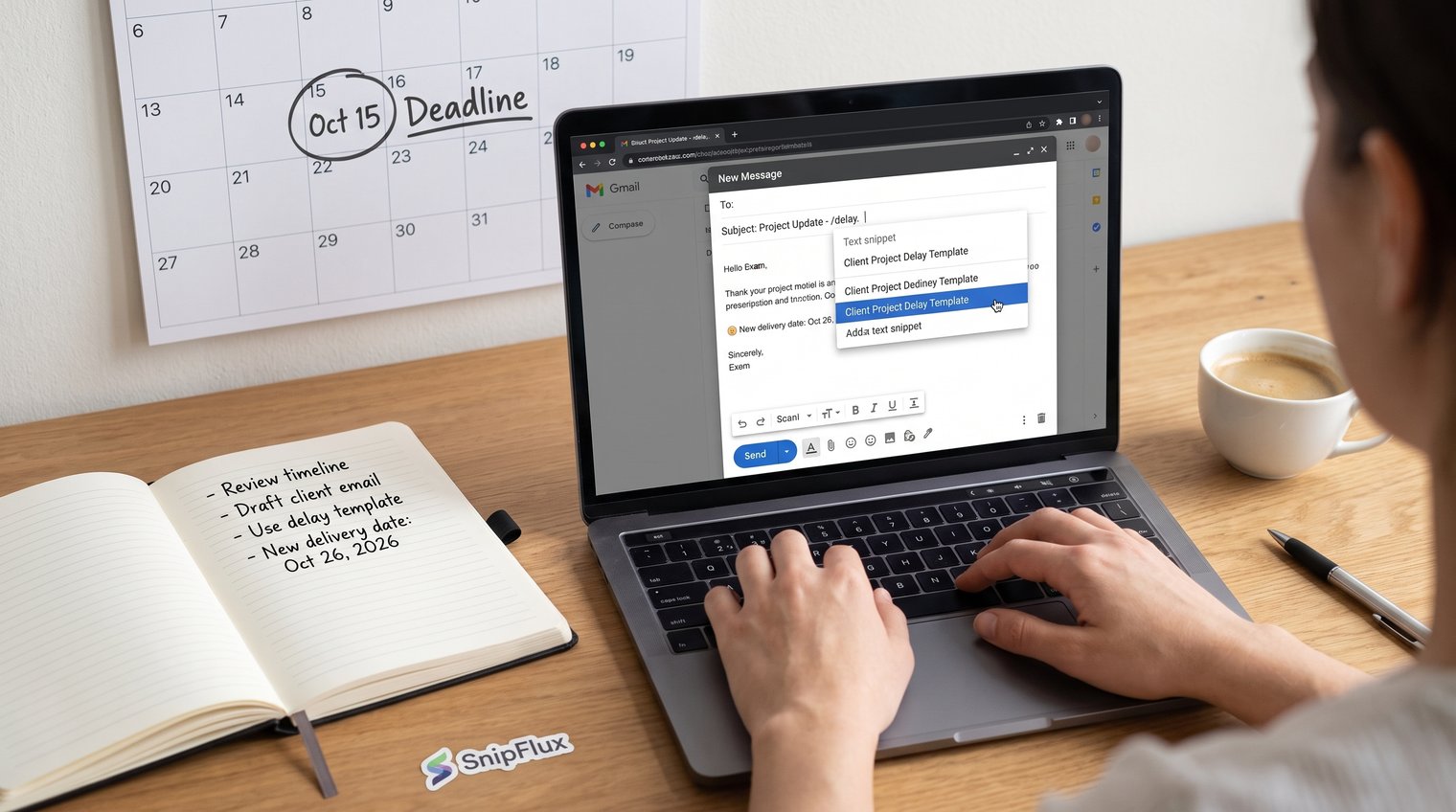
Freelancers who handle multiple clients can save these frameworks as reusable snippets, then customize the names, dates, deliverables, and context for each message. That reduces the friction of sending an update promptly, especially when you are already managing a schedule problem.
SnipFlux is a cross-platform text expander and snippet manager that can help you retrieve and adapt frequently used client-update templates across Chrome, macOS, and Windows. For example, a shortcut such as /delay-short can insert your short-extension framework, while /awaiting-feedback can pull up a dependency follow-up.
Do not automate away personalization. A template should help you communicate faster, not produce a generic message that ignores the client's project, priorities, or constraints.
Send the update early and follow through on the new plan
A timely, specific delay message with a realistic revised date is far more credible than silence or an unsupported promise. Choose the template closest to your situation, personalize it with the actual project details, and send it as soon as you see the risk.
Then honor the next check-in you promised. Even if the final delivery date changes again, a scheduled update shows the client that you are managing the issue rather than avoiding it. If client communication is a regular part of your freelance work, save these templates as editable snippets in SnipFlux so the right starting point is always close at hand.