A construction project manager resume can look polished and still fail to earn an interview. The usual problem is not formatting. It is that the document never proves who owned the budget, schedule, field coordination, and client decisions.
A strong resume template for construction project manager roles makes those answers easy to find. Use the nine tips below to build a version that works for general contractors, owners' representatives, commercial builders, and independent consultants without burying your best work in generic claims.
Choose the resume format construction hiring managers can scan quickly
For most experienced construction project managers, a reverse-chronological resume is the best choice. Put your most recent role first, keep the document to one or two pages, and make each position show a clear progression of project responsibility. Owners, general contractors, and recruiters usually want to know what you have delivered lately, at what scale, and in what type of environment.
A hybrid format can help if you are moving from superintendent, estimator, or assistant PM work into project management, or if you are a freelancer with several client engagements. Start with a concise profile and relevant skills, then use a chronological work history to establish credibility. Do not let a skills-heavy format replace real project evidence; construction hiring managers will still look for budgets, schedules, scopes, and outcomes.
Use a simple resume template for construction project manager applications: clear headings, standard fonts, ample white space, and predictable dates. Draft it in Word or a compatible editor so it is easy to update, then export a PDF when the employer requests one. The layout should help a reader identify your specialty and project leadership experience within seconds.
1. Build a header that immediately establishes your construction specialty
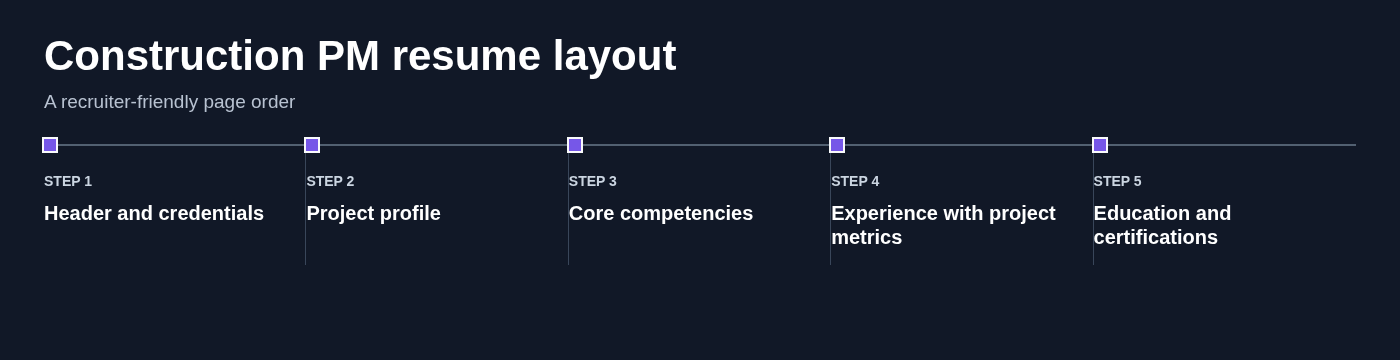
Your header should do more than identify you. It should position you for the kind of work you want. Include your name, city and state, phone number, professional email address, LinkedIn profile, and, where useful, a portfolio or project-list link.
Directly beneath your name, use a truthful role label that carries useful context. For example: "Construction Project Manager | Commercial Interiors and Healthcare Renovations" or "Senior Project Manager | Multifamily Ground-Up Construction." Those terms help a recruiter understand your background before they reach your first job entry.
Credentials can sit beside your title when they are relevant, such as PMP, CCM, LEED AP, or OSHA training. Freelancers should be equally clear: "Independent Construction Project Manager | Owner Representation | Greater Dallas Area" is more useful than simply listing "Consultant." Keep the header compact. It is not the place for a long software list, a full street address, or every project you have touched.
2. Write a project-focused professional summary, not a generic objective
Skip the generic objective statement. "Seeking a challenging position with room for growth" tells a hiring manager nothing about your ability to deliver work. Replace it with a short summary that explains the projects you lead and the outcomes you protect.
A reliable formula is: years of experience + project type or scale + leadership scope + strongest commercial outcome. Use real proof points, such as contract value, schedule performance, safety results, subcontractor coordination, change-order recovery, or margin protection.
Experienced PM example: Construction project manager with 12 years of experience delivering commercial, healthcare, and tenant-improvement projects valued from $2M to $35M. Leads preconstruction, buyout, CPM scheduling, subcontractor coordination, and closeout while maintaining client communication and protecting budget and schedule commitments.
Freelance PM example: Independent construction project manager supporting owners on occupied-building renovations and capital improvements. Experienced in permitting, bid leveling, vendor management, draw reviews, and turnover for projects up to $8M, with a focus on reducing disruption and keeping stakeholders informed.
Keep this section to three or four lines. It should create a reason to read the rest of the resume, not repeat the entire work history.
3. Put the right construction project manager keywords in a dedicated skills section
A dedicated skills section makes the resume easier for both applicant tracking systems and busy reviewers to scan. The mistake is dumping every construction term you have heard into one dense line. Group skills by the work they support.
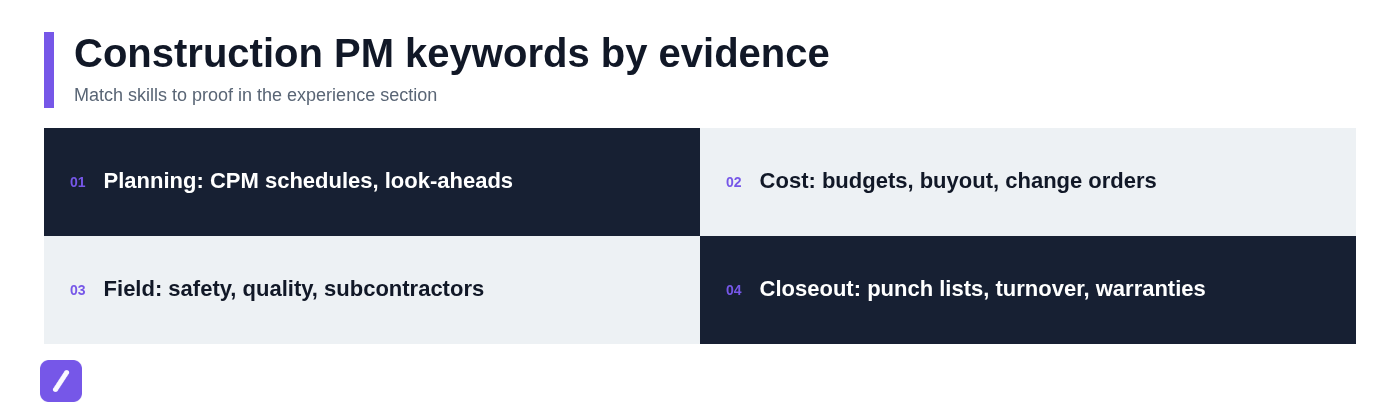
- Project delivery: preconstruction, estimating, budgeting, procurement, CPM scheduling, RFIs, submittals, change orders, closeout.
- Field operations: subcontractor coordination, look-ahead planning, quality control, safety coordination, punch lists, inspections.
- Financial controls: buyout, cost forecasting, pay applications, draw coordination, budget variance tracking, change-order recovery.
- Software: Procore, Bluebeam, Primavera P6, Microsoft Project, Autodesk Build, or other tools you have actually used.
- Credentials: OSHA training, PMP, CCM, LEED, contractor licenses, and relevant certifications.
Prioritize the language in the job posting where it honestly matches your experience. If a role calls for Primavera P6, include it only if you have used it. A keyword may help your resume get found, but unsupported terminology will be exposed quickly in an interview.
4. Turn each job entry into a project-delivery case study
Your experience section is where a construction project manager resume becomes persuasive. Avoid vague bullets such as "managed projects from start to finish" or "responsible for subcontractors." Those statements are too broad to show what you owned.
Instead, use a repeatable formula: action + project context + scope or value + method + measurable result. Name the asset type, delivery method, budget range, team size, and schedule responsibility when confidentiality permits. A reader should be able to picture your role from preconstruction through closeout.
For example: "Directed preconstruction through turnover for a $14M occupied healthcare renovation, coordinating 22 trade partners, weekly owner meetings, and phased work plans that maintained clinic operations and achieved substantial completion two weeks ahead of the contractual milestone."
Another strong bullet might read: "Led buyout, RFI and submittal workflows, cost forecasting, and change-order negotiation for a 180-unit multifamily project; recovered 78% of documented owner-driven scope changes and held final cost within 1.5% of the approved budget." Use only figures you can defend, but do use numbers whenever they clarify the scale or result.
Use metrics that prove cost, schedule, safety, and quality results
Construction outcomes are measurable, so your resume should be too. Useful metrics include budget variance, revenue or margin protected, change orders recovered, days saved, RFI turnaround time, number of subcontractors coordinated, incident rate, punch-list reduction, warranty-call reduction, and owner satisfaction indicators.
If exact project figures are confidential, use ranges, percentages, or carefully stated scale. "Managed projects ranging from $5M to $20M" is credible. So is "reduced closeout punch items by 30%" or "maintained cost variance within 2%." Do not invent precision you cannot verify.
Show both field leadership and stakeholder communication
Strong PMs do not only update schedules from behind a desk. They coordinate with superintendents, architects, engineers, owners, inspectors, suppliers, and subcontractors while turning competing priorities into workable decisions.
Include evidence of field presence and communication discipline: leading OAC meetings, resolving design conflicts, escalating risks, issuing status reports, coordinating inspections, or explaining schedule impacts to clients. Technical execution matters, but construction leaders are hired because they can keep people aligned when the job gets complicated.

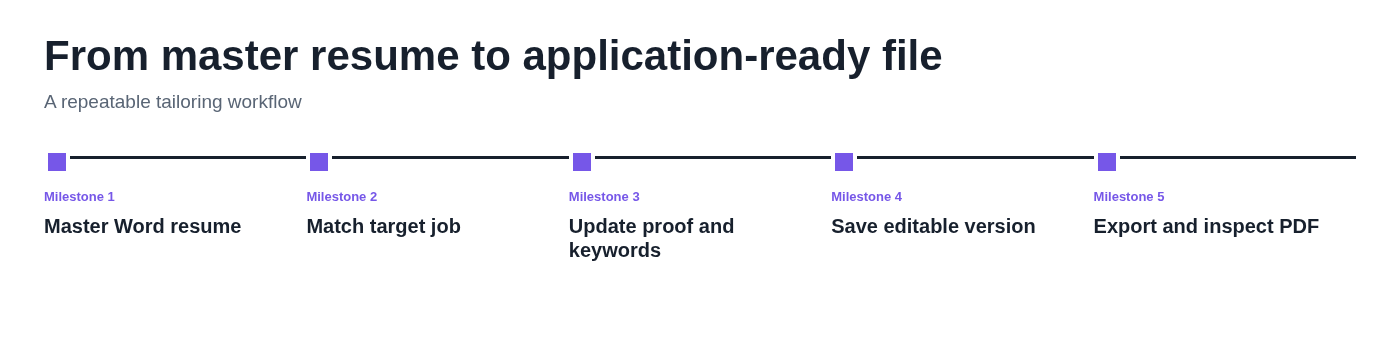
5. Tailor one master resume template for each target role and project type
Build one detailed master resume, then create focused versions for the jobs you actually want. A general contractor hiring for ground-up commercial work evaluates experience differently from an owner's representative seeking renovation oversight. The format can stay the same; the evidence should change.
Keep variations for the markets that reflect your background: commercial, multifamily, residential, civil, healthcare, renovation, general contracting, or owner representation. For each application, mirror the job title when it is truthful, reorder the summary and skills, select the most relevant projects, and elevate results that address the employer's stated challenges.
- For a GC role, lead with buyout, subcontractor management, field coordination, cost control, and schedule delivery.
- For an owner's representative role, emphasize stakeholder reporting, design coordination, budget oversight, risk management, and decision support.
- For healthcare or occupied renovation work, highlight phasing, safety, infection-control requirements where applicable, and minimizing operational disruption.
- For civil or infrastructure work, foreground permitting, public stakeholders, procurement requirements, utility coordination, and schedule controls when relevant.
A reusable template saves time, but sending the identical resume to every employer is not efficiency. It is missed relevance.
6. Make freelance and consulting construction PM work look as credible as staff experience
Independent work should not look like a string of unrelated short-term jobs. List it under a single employer-style heading, such as "Independent Construction Project Manager" or "Construction Project Management Consultant," then nest representative client projects beneath it.
This approach communicates continuity while allowing you to show range. Under that role, identify the type of assignment and your responsibility: owner representation for a retail renovation, permitting and bid leveling for a residential addition program, draw coordination for a multifamily rehab, or turnover management for a commercial fit-out.
Freelance bullets should be as specific as staff-role bullets. For example: "Represented owner on a $3.2M restaurant renovation program, coordinating permit milestones, bid comparisons, vendor contracts, weekly progress reviews, and final turnover across three locations." Or: "Reviewed contractor pay applications and change requests for capital improvements, improving documentation quality and helping the owner resolve disputed scope before work proceeded."
Protect client confidentiality without making your experience vague. You can describe an "occupied Class A office renovation" or a "regional retail portfolio" instead of naming the client, while still stating your project size, scope, decisions, and results.
7. Add education, licenses, and certifications where they support the role
Education and credentials should support your candidacy, not fill empty space. Include relevant degrees, PMP, CCM, LEED credentials, OSHA training, contractor licenses, and software certifications that are current and useful for the target role.
If a job posting treats a credential as a screening requirement, place it near the top of the resume after your summary or in the header area. A hiring manager should not have to hunt for an active license or required certification.
For experienced managers, a concise education section is enough: degree, school, and graduation year only if it helps. Leave off expired credentials, unrelated courses, and old training that has no bearing on how you lead projects now.
8. Use a Word template for editing and export a clean PDF for applications
If you are looking for a construction project manager resume Word template, Word remains a practical choice because it is easy to revise for each opportunity. Maintain your master file there, or in a compatible editor, and save a separate editable version for every targeted application.
When the employer asks for a PDF, submit a PDF. A construction project manager resume sample PDF can be helpful for assessing layout, but the final file still needs to contain your own specific experience. Always follow the application instructions if a company explicitly requests Word, PDF, or another format.
Use a descriptive file name, such as Jordan-Lee-Construction-Project-Manager-Resume.pdf. Before submitting, check these formatting safeguards:
- Use standard, readable fonts and clear section labels.
- Avoid text boxes, complex graphics, columns that confuse parsing, and decorative elements that can break in an ATS.
- Keep dates, job titles, company names, and bullet formatting consistent.
- Open the exported PDF on a separate device or viewer to catch line breaks, missing bullets, and page-overflow issues.
- Keep the editable Word version alongside the final PDF so future tailoring does not require rebuilding the document.
9. Run a final credibility and ATS check before you apply
The final review is not just a spelling check. Read the resume as if you were deciding whether to trust someone with a complicated project. Does the job title align with the opening? Do the bullets show results, not only duties? Are the project terms accurate?
- Confirm that contact details, LinkedIn information, dates, job titles, and company names are accurate.
- Check that your current role uses present tense and prior roles use past tense.
- Verify the spelling of project management software, certifications, construction terminology, and client-facing titles.
- Make sure quantified results are defensible and that confidential work is described safely.
- Review the rendered PDF for broken formatting, blank pages, and unreadable spacing.
Ask a trusted construction peer, former supervisor, or recruiter to review the document if possible. They can tell you whether it presents a coherent project story: what you build, what you own, where you add value, and why you are ready for the next level.
ATS compatibility helps your resume get discovered. Specific evidence of cost, schedule, safety, quality, and stakeholder leadership is what persuades the human reviewer to call you.
A construction PM resume template works when every line proves project ownership
The best resume template for construction project manager roles is clean enough to scan and detailed enough to prove delivery leadership. Focus on the projects you led, the scope you controlled, and the results you produced across budget, schedule, safety, quality, and client communication.
Once you have strong language for project summaries, proposal responses, client updates, or applications, keep approved versions organized in SnipFlux so you can reuse them without rewriting the same message from scratch.